
Direct Answer
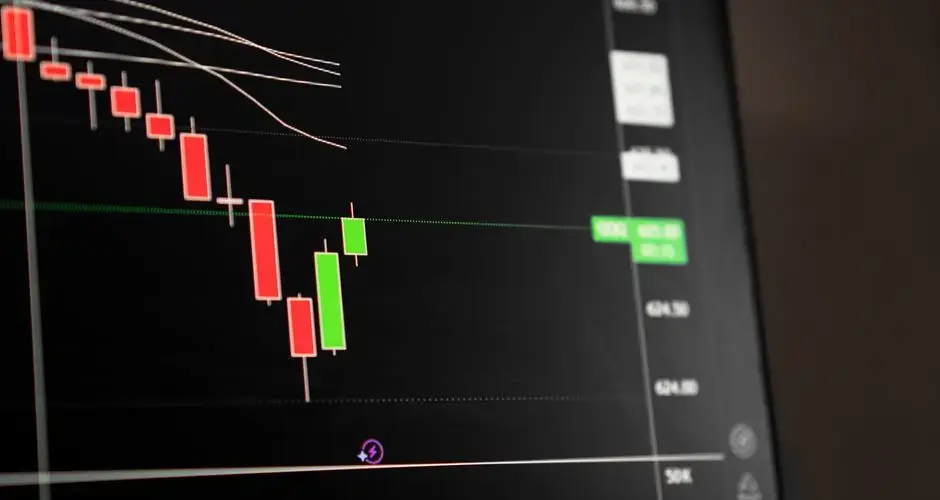
The on-neck pattern is made up of two candles appearing within an established downtrend. The first is a long bearish candle, showing sellers firmly in control of the period.
Key Takeaways
- The on-neck pattern is a two-bar bearish continuation pattern that appears within a downtrend.
- The first bar is a long bearish candle; the second bar gaps down at the open, then rallies to close only at (or very near) the first bar's low.
- It's a shallower variant of the in-neck pattern, both describe a weak bounce that fails to reclaim much of the prior bar's range.
- Because the second bar's close lands right at the first bar's low rather than above its close, it's generally read as an even weaker bullish attempt than an in-neck pattern.
- The shallow bounce is often mistaken for a genuine reversal signal, when the pattern actually reinforces that the downtrend is likely to continue.
On-Neck Pattern Candlestick Pattern: Formation, Meaning, and Signals
An on-neck pattern is a two-bar bearish continuation candlestick pattern that forms in a downtrend, where a gap-down second bar rallies only enough to close at the first bar's low. It's a shallower variant of the in-neck pattern, and its narrow bounce is generally read as a weak bullish attempt that reinforces the existing downtrend rather than reversing it.
What Is an On-Neck Pattern?
The on-neck pattern is made up of two candles appearing within an established downtrend. The first is a long bearish candle, showing sellers firmly in control of the period. The second bar opens with a gap down, below the first bar's close, but buyers step in during the bar and push price back up. That rally stalls right at (or very near) the first bar's low, which is where the pattern gets its name: the second bar's close sits "on the neck" of the prior candle.
Because the bounce fails to climb back into the first bar's real body at all, the pattern is read as a weak, short-lived recovery attempt rather than a genuine change in control. It's closely related to, and a shallower version of, the in-neck pattern, which differs only in exactly where the second bar's close lands.
How an On-Neck Pattern Forms
Formation happens in two steps within a downtrend. First, a long bearish candle closes near its low, confirming sellers are in control. Second, the following bar opens with a gap down, below the first bar's close, but buyers push the bar's price back up during the session. The close of that second bar lands at or very near the first bar's low, not above it.

That specific close location is what separates the on-neck pattern from its relatives: an in-neck pattern's second bar closes just above the first bar's close, while a piercing pattern's second bar closes more than halfway into the first bar's body. The on-neck pattern's close is the shallowest of the three, sitting right at the neckline formed by the first bar's low.
On-Neck Pattern Example
The chart below shows a deterministic, illustrative example: a downtrend leading in, the two-bar on-neck pattern forming, then two possible continuations, a confirmation (price follows through lower, continuing the downtrend) and a failure/look-alike (price instead reclaims the first bar's range). Toggle between them to see why the shallow bounce alone doesn't decide the outcome.
How to Trade an On-Neck Pattern
Read it as a weak bullish attempt
Because the second bar's close lands right at the first bar's low rather than above its close. This is generally read as an even weaker bullish attempt than an in-neck pattern. That reading reinforces the existing downtrend rather than suggesting a reversal is underway.
Wait for confirmation
The pattern itself only describes two bars and a shallow bounce. Most approaches wait for a subsequent bar to close below the second bar's low before treating the downtrend continuation as confirmed, rather than acting on the two-bar pattern alone.
Define invalidation before acting
If a following bar instead closes back above the first bar's close, the weak-bounce reading is invalidated, buyers reclaimed more ground than the on-neck pattern implies they could. Defining that level in advance keeps the invalidation rule honest.
Common On-Neck Pattern Mistakes
- Confusing on-neck with in-neck, an on-neck pattern closes at the first bar's low, while an in-neck pattern closes just above the first bar's close; the two are distinguished by exactly where the second bar's close lands.
- Treating the shallow bounce as a genuine reversal signal, the pattern describes a weak bullish attempt within a downtrend, not a change in control.
- Trading the pattern without confirmation, acting before a subsequent bar closes below the second bar's low skips the follow-through check that separates continuation from a stalled downtrend.
- Ignoring where the pattern appears, the on-neck pattern only has continuation meaning inside an existing downtrend, not in a sideways or uptrending market.
On-Neck Pattern vs. Similar Patterns
| Pattern | Second bar close | Key difference from an on-neck pattern |
|---|---|---|
| On-Neck Pattern | At/near first bar's low (shallowest) | Baseline, weakest bounce of the three, reinforces downtrend continuation |
| In-Neck Pattern | Barely above first bar's close (shallow) | Slightly deeper bounce, but still read as a weak continuation signal |
| Piercing Pattern | Over 50% into first bar's body (deep) | A genuine bullish reversal signal, not a continuation pattern |
Limitations of the On-Neck Pattern
The on-neck pattern describes the relationship between two bars' opens, closes, and one bar's low, it doesn't tell you why buyers stepped in, how much volume backed the bounce, or how far the following continuation might travel. Like any two-bar pattern, it works best combined with the broader trend, nearby support and resistance, and a defined confirmation and invalidation plan, not used alone as a standalone trading signal.
The Shallowest of the Three, and the Most Bearish
On-neck is the weakest bounce in the family: the second bar closes at or very near the prior bar low, reclaiming essentially nothing after gapping down. Because the scale runs from this through in-neck and thrusting up to piercing, and because bearish continuation strengthens as the bounce weakens, this is the most bearish reading of the group. That inversion is worth holding onto, since a smaller-looking recovery is the stronger signal here.
The identification is a comparison against one price, the first bar low, so it is checkable rather than impressionistic. Closing meaningfully above it moves the pattern to in-neck; closing below is a different situation entirely.
The gap down at the open is required. Without it, the second bar is simply a weak session following a strong decline, and the sequence the pattern describes, an attempt lower followed by a failed recovery, has not occurred.
And it is a continuation reading, so it needs an established downtrend around it. Two bars in isolation describe a gap and a stall, which is common and carries no directional claim.
On-Neck Pattern FAQs
Is the on-neck pattern bullish or bearish?
The on-neck pattern is a bearish continuation pattern. It appears within a downtrend and, when confirmed, suggests the downtrend is likely to continue rather than reverse.
What's the difference between an on-neck pattern and an in-neck pattern?
Both are two-bar bearish continuation patterns with a long first bar and a gap-down second bar that rallies back. The difference is where the second bar closes: an on-neck pattern closes at or very near the first bar's low, while an in-neck pattern closes just above the first bar's close, a slightly deeper bounce.
Does the on-neck pattern need confirmation?
Yes. The pattern itself only describes two bars and a shallow bounce. Most approaches wait for a subsequent bar to close below the second bar's low before treating the downtrend continuation as confirmed.
Why is the on-neck pattern considered a weak bullish attempt?
Because the second bar's rally stalls right at the first bar's low rather than reclaiming any of the first bar's close, it shows buyers could not push price meaningfully back into the prior bar's range, a weaker recovery than an in-neck pattern, let alone a piercing pattern.
How is an on-neck pattern different from a piercing pattern?
A piercing pattern is a bullish reversal where the second bar closes more than halfway into the first bar's body. An on-neck pattern is the opposite in both direction and depth: it's a bearish continuation where the second bar's close barely reaches the first bar's low.
Which price does the second bar close at in an on-neck pattern?
At or very near the low of the previous candle, which is the shallowest of the four penetration levels in this family. The second bar gaps down, rallies, and manages only to reach the level where the previous session bottomed. That is the weakest of the recoveries the family describes, which is why the pattern is read as continuation rather than reversal.
What tolerance applies to the close matching the previous low?
A band is required, since closing exactly at the previous low is uncommon in finely quoted instruments. The tolerance determines whether an instance is classified as on-neck or as in-neck, since the two are adjacent on the penetration continuum. Moving the band therefore reassigns instances between two named patterns rather than simply changing a count.
Does the on-neck pattern have an equivalent within advances?
The mirror structure occurs and is not named in the classical catalogue, which defines the neck patterns as bearish continuation within declines. Anyone scanning symmetrically has to construct the inverted conditions rather than look up a name. The asymmetry is a historical accident of how the patterns were catalogued rather than a statement about market behaviour.
Why does the second candle have to gap down at the open?
Because the pattern is about a failed recovery from a lower open. The gap establishes that sellers pushed price below the previous session before buyers appeared, and the close at the previous low measures how little of that they recovered. Without the gap the second candle simply opens near the previous close and there is no shortfall to measure.
References
- CMT Association: Technical Analysis Body of Knowledge and Research
- CFA Institute Research and Policy Center: Investment Research
- Steve Nison, Japanese Candlestick Charting Techniques (1991), the book credited with popularizing Japanese candlestick analysis in Western markets.
- SEC Investor.gov: Introduction to Investing