
Direct Answer
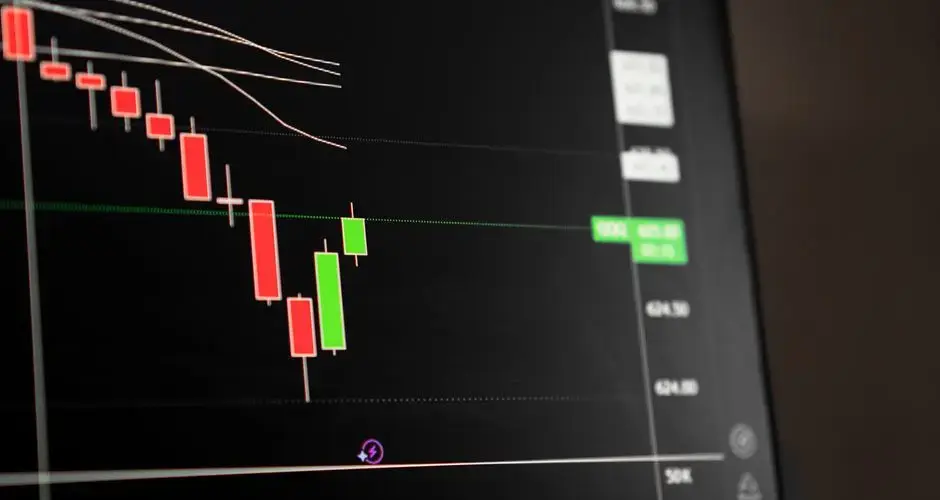
A Piercing Pattern is built from two consecutive bars during a downtrend. The first bar is a long bearish (red) candle, confirming that sellers are pushing price lower.
Key Takeaways
- A Piercing Pattern is a two-bar bullish reversal setup appearing after a downtrend, the mirror image of Dark Cloud Cover.
- The first bar is a long bearish candle; the second bar opens below the first bar's low (a gap down) but rallies to close more than halfway into the first bar's real body.
- The gap-down open followed by a strong close back into the prior body shows sellers were initially in control before buyers overwhelmed them intraday.
- The deeper the second bar closes into the first bar's body, the stronger the signal, over 50% penetration is the minimum definition, not a strong-signal threshold on its own.
- It is often confused with Bullish Engulfing, which requires no gap and a full body engulfment rather than a gap-down open with partial penetration.
Piercing Pattern Candlestick: Formation, Meaning, and Signals
A Piercing Pattern is a two-bar bullish reversal candlestick pattern that appears after a downtrend: a long bearish candle is followed by a candle that gaps down at the open but rallies to close more than halfway into the first candle's body. It signals that sellers lost control intraday, and its reliability depends on the trend it interrupts and whether the next bar confirms the reversal.
What Is a Piercing Pattern?
A Piercing Pattern is built from two consecutive bars during a downtrend. The first bar is a long bearish (red) candle, confirming that sellers are pushing price lower. The second bar opens below the first bar's low, a gap down that would normally suggest the downtrend is continuing or even accelerating.
Instead, buyers step in during the second bar and push price back up, closing the bar more than halfway into the first candle's real body. That combination, a bearish gap-down open followed by a strong bullish close deep into the prior body, is what defines the pattern. It's read as evidence that sellers were briefly in control at the open but were overwhelmed by buying pressure before the close.
The Piercing Pattern is the mirror image of Dark Cloud Cover, which shows the same two-bar mechanics in reverse: a bullish first bar, a gap-up open, and a bearish close deep into the first body, signaling a bearish reversal instead.
How a Piercing Pattern Forms
Two conditions have to hold for a two-bar setup to qualify as a Piercing Pattern. First, the second bar's open must be below the first bar's low, a genuine gap down, not just a lower open within the prior bar's range. Second, the second bar's close must land more than halfway into the first bar's real body, measured from the first bar's close up toward its open.
Both conditions matter: a gap down followed by a close that recovers only slightly into the first body isn't a Piercing Pattern by the standard definition, and a strong close into the first body without the initial gap-down open is a different pattern (Bullish Engulfing) rather than a Piercing Pattern. The deeper the penetration past the halfway point, the more the pattern is read as a decisive rejection of the prior bar's selling pressure.
Piercing Pattern Example
The chart below shows a deterministic, illustrative example: a downtrend leading in, the two-bar Piercing Pattern forming, then two possible continuations, a confirmation (price follows through with a higher close) and a failure/look-alike (price fails to hold the gains). Toggle between them to see why the pattern alone doesn't decide the outcome.
How to Trade a Piercing Pattern
Wait for confirmation
Confirmation typically means the next bar closes above the second bar's high. Because the pattern itself is only two bars, treating it as actionable before that follow-through skips the step that separates a genuine reversal from a temporary bounce inside an intact downtrend.

Weigh the depth of penetration
The deeper the second bar closes into the first bar's body, the stronger the signal, over 50% penetration is only the minimum definition, not evidence of a strong setup on its own. A close that barely clears the halfway mark carries less weight than one that closes near the top of the first bar's body.
Don't confuse it with Bullish Engulfing
A Piercing Pattern requires the gap-down open that Bullish Engulfing does not; Bullish Engulfing instead requires the second bar's body to fully engulf the first bar's body, with no gap requirement at all. Confirming which condition is actually present, a gap plus partial penetration, or a full-body engulfment, matters before naming the pattern.
Common Piercing Pattern Mistakes
- Treating any two-bar bounce after a downtrend as a Piercing Pattern, without checking specifically for the gap-down open, a strong second-bar close alone doesn't qualify.
- Accepting bare 50% penetration as strong confirmation, a close that barely crosses the halfway mark meets the minimum definition but isn't, by itself, a strong signal.
- Confusing it with Bullish Engulfing, the two patterns have different gap and penetration requirements and shouldn't be used interchangeably.
- Skipping the next-bar confirmation step, acting on the two-bar pattern alone, before the next bar closes above the second bar's high, skips the check that filters out failed reversals.
Piercing Pattern vs. Similar Patterns
| Pattern | Gap requirement | Key difference from a Piercing Pattern |
|---|---|---|
| Piercing Pattern | Gap down open | Baseline, closes more than 50% into the prior bearish body |
| Bullish Engulfing | None required | Second body fully engulfs the first body, open to close, with no gap needed |
| Bullish Harami | None required | Second body is small and fully contained within the first body |
| Dark Cloud Cover | Gap up open | The bearish mirror image, same mechanics, opposite direction |
Limitations of the Piercing Pattern
A Piercing Pattern describes the open-to-close relationship of two bars, not a forecast. It carries no information about volume, order flow, or why the second bar's buyers stepped in, a gap driven by scheduled news behaves differently from one that formed on ordinary trading. It also says nothing about the size of any follow-through move: a confirmed Piercing Pattern can precede a large rally or a shallow, short-lived bounce. Like any two-bar pattern, it works best combined with trend context, support levels, and a defined confirmation and invalidation plan, not used alone.
More Than Halfway Is a Measurement, Not an Impression
The threshold in this pattern is arithmetic. Take the first bar open and close, find the midpoint, and check whether the second bar closed above it. Doing that rather than judging by eye matters because a close that lands just under the midpoint is a materially weaker session than one well above it, and on a chart the two look nearly identical. The number is the pattern.

The other strict requirement is that the second bar opens below the first bar low, a genuine gap down rather than a lower open. The sequence the pattern describes is sellers pushing to a new low at the open and buyers taking the session back through it, and without the gap that story does not hold.
Those two conditions together make the pattern scarce in continuously traded markets, where opening gaps have no session boundary to form against.
It is the mirror of dark cloud cover and carries the same dependency on the preceding trend. After a genuine decline it describes buyers reclaiming ground; without one, it is a lower open that recovered, which happens frequently and means little.
Piercing Pattern FAQs
Is a Piercing Pattern always a bullish reversal signal?
No. A Piercing Pattern describes a specific two-bar relationship, a gap-down open followed by a close over halfway into the prior bar's body, but whether it actually reverses the trend depends on the surrounding downtrend, nearby support, and what the next bar does.
What's the difference between a Piercing Pattern and Bullish Engulfing?
A Piercing Pattern requires the second bar to open below the first bar's low (a gap down) and close more than halfway into the first body. Bullish Engulfing has no gap requirement, its second body simply has to fully engulf the first body, open to close.
Does a Piercing Pattern need confirmation?
Yes. Confirmation typically means the next bar closes above the second bar's high. A close that barely crosses the 50% penetration mark is a weaker signal on its own and benefits from that follow-through.
What invalidates a Piercing Pattern signal?
If price fails to follow through and instead closes back below the second bar's low, the tentative bullish reversal reading is invalidated and the downtrend is treated as intact.
How is a Piercing Pattern different from a Bullish Harami?
A Bullish Harami's second body is small and fully contained within the first body, with no gap-down open. A Piercing Pattern's second bar gaps below the first bar's low and then closes deep into, more than halfway through, the first body.
How does the piercing pattern relate to the thrusting, in-neck and on-neck patterns?
They form one continuum measured by how far the second candle closes into the first body. On-neck reaches the previous low, in-neck moves marginally into the body, thrusting closes further in but below the midpoint, and piercing closes above the midpoint. Only the last is read as a bullish reversal; the others are read as continuation of the decline.
Does volume add anything to a piercing pattern?
It distinguishes a recovery that absorbed real supply from one that occurred on very little activity. The pattern rests on buyers reversing most of the previous session decline, and the same shape can be produced by a thin session drifting higher. Comparing the second candle volume against a recent average is the check, and it is one the pattern definition omits.
How does a piercing pattern look on a chart including the overnight session?
The gap down that opens the pattern is absorbed into continuous trading, so the second candle no longer opens below the previous session low. The distinctive structure, a lower open recovered strongly, becomes an ordinary rally. The pattern therefore appears on a regular-session chart of an instrument and is absent from a continuous chart of the same instrument.
Is a piercing pattern read differently inside a range?
Yes, and the difference matters because the geometry is common. Inside a range the pattern describes price bouncing off the lower boundary, which is expected behaviour rather than a reversal of anything. The bullish reading requires a preceding decline for the pattern to reverse, and the two bars themselves cannot establish whether that decline occurred.
References
- CMT Association: Technical Analysis Body of Knowledge and Research
- CFA Institute Research and Policy Center: Investment Research
- Steve Nison, Japanese Candlestick Charting Techniques (1991), the book credited with popularizing Japanese candlestick analysis in Western markets.
- SEC Investor.gov: Introduction to Investing