
Direct Answer
A bearish kicker is a two-bar pattern that appears after an uptrend. The first bar is a bullish candle that continues the existing trend, showing buyers still in control.
Key Takeaways
- A bearish kicker is a two-bar reversal pattern that appears after an uptrend, made up of a bullish bar followed immediately by a long bearish bar.
- The second bar opens with a gap below the entire range of the first bar, there is no overlap at all between the two candle bodies.
- Because the break is complete, with zero overlap between the bullish and bearish bodies, a kicker is considered one of the more decisive single-signal reversal patterns.
- The gap level itself, the second bar's open, serves as a natural, tight invalidation reference for traders acting on the pattern.
- A bearish kicker is often confused with bearish engulfing, but the two patterns are defined by opposite structures: engulfing requires overlap, a kicker requires none.
Bearish Kicker Candlestick Pattern: Formation, Meaning, and Signals
A bearish kicker is a two-bar candlestick reversal pattern that appears after an uptrend, where a bullish candle is followed by a long bearish candle that gaps down below the entire prior bar's range. The two bodies have no overlap at all, marking a complete break in sentiment between the two bars.
What Is a Bearish Kicker?
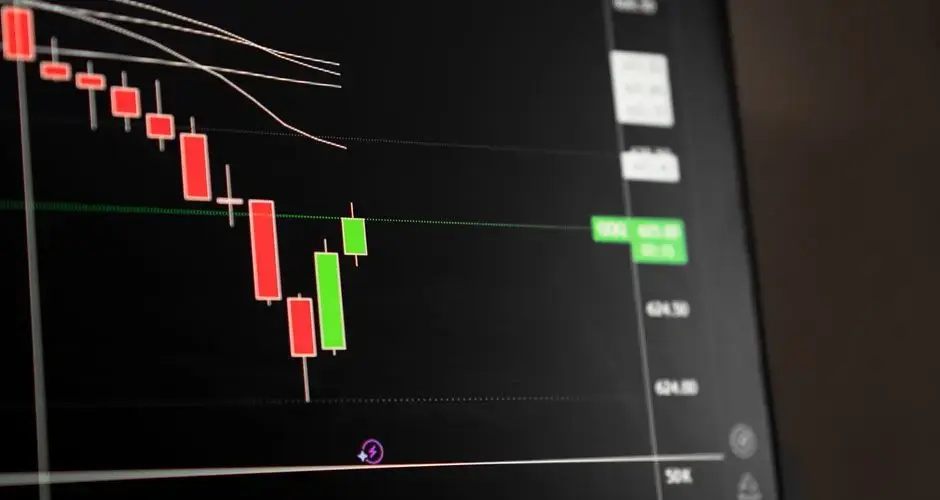
A bearish kicker is a two-bar pattern that appears after an uptrend. The first bar is a bullish candle that continues the existing trend, showing buyers still in control. The second bar reverses that entirely: it opens with a gap below the whole range of the first bar and closes as a long bearish candle.
What separates a bearish kicker from most other reversal patterns is the total absence of overlap between the two bodies. The first bar's body sits entirely above the second bar's body, with a clean gap between them. That complete break, rather than a gradual overlap or fade, is what defines the pattern and what traders read as a sudden shift in sentiment between the two bars.
How a Bearish Kicker Forms
The first bar is a bullish candle that fits the ongoing uptrend, nothing about it looks unusual on its own. The second bar is where the pattern is made: it opens with a gap in the opposite direction, below the entire range of the first bar, and then trades lower to close as a long bearish candle.
Because the second bar's open already sits below the first bar's low, there is no overlap between the two candle bodies whatsoever. This is the defining structural requirement of a kicker, not the size of either candle individually, but the complete gap between them.
Bearish Kicker Example
The chart below shows a deterministic, illustrative example: an uptrend leading in, a bearish kicker forming, then two possible continuations, a confirmation (price follows through lower) and a failure/look-alike (price recovers back through the gap instead). Toggle between them to see why the gap alone doesn't guarantee follow-through.
How to Trade a Bearish Kicker
Why the gap matters
Because the gap is a complete break with no overlap between the two bodies, a bearish kicker is considered one of the more decisive single-signal reversal patterns. Unlike patterns that require waiting for overlap or a gradual shift, the kicker's structure itself already shows an abrupt change in sentiment between the two bars.
Using the gap as invalidation
The gap level itself, the second bar's open, is a natural, tight invalidation reference. Because the entire pattern depends on that gap holding, price trading back up through it undermines the premise of the signal in a way that's easy to define and monitor.
Common Bearish Kicker Mistakes
- Treating any large bearish candle after a bullish one as a kicker, without confirming the total lack of overlap between the two bodies, it may just be an ordinary down day.
- Confusing it with bearish engulfing, bearish engulfing requires the second body to overlap and engulf the first, which is the opposite structure of a kicker's complete gap.
- Skipping the trend context, the pattern is defined relative to an uptrend that preceded it; the same two-bar shape without that context isn't read the same way.
Bearish Kicker vs. Similar Patterns
| Pattern | Bars | Key difference from a bearish kicker |
|---|---|---|
| Bearish Kicker | 2 | Baseline, complete gap, zero overlap between opposite-colored bodies |
| Bearish Engulfing | 2 | Second body overlaps and engulfs the first; no gap required |
| Bearish Breakaway | 5 | A drift phase unfolds over several bars before the reversal, not an immediate gap-and-reverse |
Limitations of the Bearish Kicker Pattern
A bearish kicker describes the relationship between two bars' open, close, and range, it does not tell a trader why the gap occurred, how much volume confirmed it, or how far a subsequent move will travel. Like any two-bar pattern, it works best read in the context of the broader trend and combined with a defined invalidation plan, rather than treated as a standalone forecast of future price movement.
The Move Already Happened Before You Saw It
The bearish kicker is often described as one of the more emphatic reversal patterns, and the reason it is emphatic is also the reason it is hard to use. A complete break with no overlap between the two ranges means price has already relocated by the time the pattern is visible. Acting on it is acting after the repricing, and the entry sits below a gap that will not be revisited unless the move fails.
That makes the stop question awkward. The natural invalidation, back above the first bar range, is on the other side of the gap, so a position taken on the second bar carries a wide defined risk and needs sizing against that distance rather than against the candle.
The requirement itself is strict: a gap below the entire prior range, with the bodies showing no overlap at all. Patterns that nearly qualify are common; ones that actually do are not, and the difference is worth checking rather than assuming.
Since a gap of that size needs a market that closes, this pattern is largely a session-based-market phenomenon, and the cause behind it usually lives outside the chart entirely.
Bearish Kicker FAQs
What makes a bearish kicker different from a normal reversal candle?
A bearish kicker requires a complete gap: the second bar opens below the entire range of the first bar, leaving no overlap between the two bodies. A normal reversal candle can simply open within the prior bar's range and still close lower.
Is a bearish kicker the same as bearish engulfing?
No. Bearish engulfing requires the second body to overlap and engulf the first body, with no gap needed. A bearish kicker requires the opposite, a complete gap with zero overlap between the two bodies.
Why is a bearish kicker considered a decisive signal?
Because the gap is a total break with no overlap between the bullish and bearish bodies, it reflects an abrupt shift in sentiment between the two bars rather than a gradual fade, which is why traders treat it as one of the more decisive single-signal reversal patterns.
Where do traders place invalidation for a bearish kicker?
The gap level itself, the second bar's open, is a natural, tight invalidation reference, since it marks the exact price where the complete break between the two bodies occurred.
What's a common mistake when identifying a bearish kicker?
Treating any large bearish candle that follows a bullish one as a kicker without confirming the total lack of overlap between the two bodies. Without a complete gap, the pattern is something else, such as bearish engulfing.
Can a bearish kicker form in a market with no session gaps?
Not in its defined form. The pattern requires the second candle to open at or beyond the first candle open and move in the opposite direction without any overlap, which needs a gap. Continuously traded markets produce that only across weekend breaks or in liquidity failures. Charts of such instruments will show very few kickers regardless of how sharp the reversals are.
Does the gap have to leave the two bodies completely separate?
That is the strict reading and it is what distinguishes the kicker from an ordinary engulfing bar. The second candle opens where the first opened or beyond it in the new direction, so the two bodies do not overlap at all. Implementations that only require a gap between the close of one and the open of the next produce a weaker and much more common pattern.
What does volume typically look like on a kicker?
The pattern is associated with a discrete event, usually an announcement, since that is what produces an opening price beyond the previous session with immediate follow-through. Volume on the second bar is therefore usually well above average. That is a consequence of the mechanism rather than a requirement of the definition, and a kicker on ordinary volume is worth examining for a data problem.
Does a bearish kicker imply a price objective?
No convention attaches a target to it. The pattern describes a sharp change in direction without any measurement that could be projected, unlike patterns with a defined height such as a chart formation. Any target used alongside a kicker comes from elsewhere on the chart, typically the nearest structural level below, and it is not derived from the pattern.
References
- CMT Association: Technical Analysis Body of Knowledge and Research
- CFA Institute Research and Policy Center: Investment Research
- Steve Nison, Japanese Candlestick Charting Techniques (1991), the book credited with popularizing Japanese candlestick analysis in Western markets.
- SEC Investor.gov: Introduction to Investing