
Direct Answer
The bearish engulfing pattern is one of the most widely recognized two-candle reversal signals in candlestick charting. It requires exactly two candles: the first is a small-bodied green candle continuing an existing uptrend, and the second is a larger red candle whose open-to-close body fully engulfs the first candle's open-to-close body.
Key Takeaways
- Only the real bodies matter for the pattern's definition, the second candle's wicks can extend beyond the first candle's wicks without affecting whether the pattern qualifies.
- The pattern requires a genuine prior uptrend; the same two-candle shape inside a downtrend or a flat range is just two candles, not a reversal signal.
- The bigger the size mismatch between the two bodies, and the higher the volume on the engulfing candle, the more decisive the reversal read.
- Most approaches wait for the next bar to close below the engulfing candle's low before treating the reversal as confirmed.
- A close back above the engulfing candle's high negates the bearish read, since buyers have reclaimed the entire range the pattern was built on.
Bearish Engulfing Candlestick Pattern: Formation, Meaning, and Signals
A bearish engulfing pattern is a two-candle formation where a large red (down) candle's real body fully contains the prior small green (up) candle's real body, after an uptrend. It's a bearish reversal signal, sellers overwhelmed the entire range buyers had just built, and the pattern's strength comes from how completely the second candle swallows the first.
What Is a Bearish Engulfing Pattern?
The bearish engulfing pattern is one of the most widely recognized two-candle reversal signals in candlestick charting. It requires exactly two candles: the first is a small-bodied green candle continuing an existing uptrend, and the second is a larger red candle whose open-to-close body fully engulfs the first candle's open-to-close body. Because the second candle's body starts above the first candle's close and finishes below the first candle's open, it represents a complete round-trip of price action, a full reversal of everything the prior bar accomplished, in a single session.
The pattern only concerns the real bodies, the rectangle between each candle's open and close. Wicks are not part of the definition: the second candle's wicks can extend above or below the first candle's wicks without changing whether the pattern qualifies. What matters is that the red body's open (near its top) sits above the green body's close, and the red body's close (near its bottom) sits below the green body's open.
How Does a Bearish Engulfing Pattern Form?
Two conditions define the pattern. First, price must be in an uptrend heading into the two-candle sequence, without prior upward momentum, an engulfing red candle doesn't represent a reversal, just continuation of an existing downtrend or noise inside a range. Second, the candle geometry itself: candle one is a small bullish (green) body, and candle two is a larger bearish (red) body whose real body fully contains candle one's real body.
Mechanically. This means candle two opens higher than candle one closed (often on a gap up or a brief early push higher) and then sells off through the entire session, closing below candle one's open. The bigger the size mismatch between the two bodies, and the higher the volume on the engulfing candle, the more decisively sellers reversed the prior session's gains.
Bearish Engulfing Example
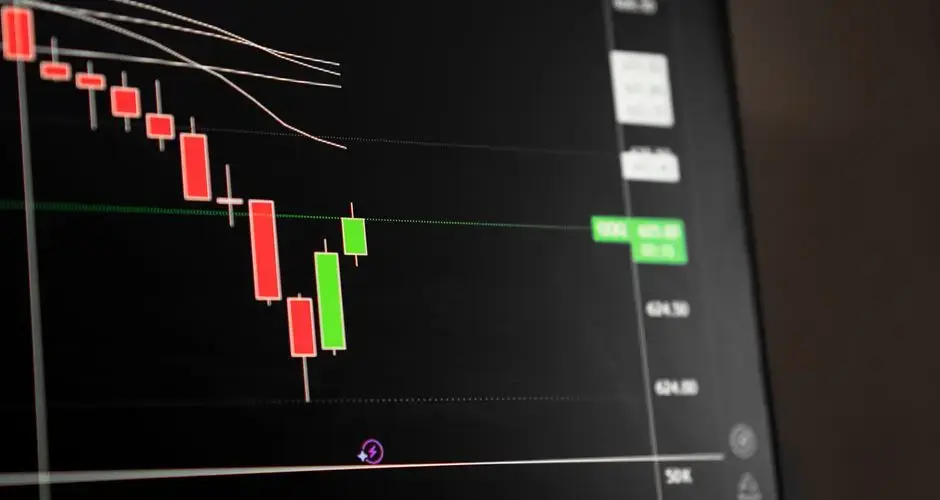
The chart below shows a deterministic, illustrative example: an uptrend leading in, the small green candle followed by the engulfing red candle, then two possible continuations, a confirmation (price keeps falling) and a failure/look-alike (price reclaims the engulfing candle's high instead). Toggle between them to see why the two-candle shape alone doesn't guarantee the reversal follows through.
How to Trade a Bearish Engulfing Pattern
Check the prior trend
A bearish engulfing pattern only means what it claims to mean if it appears after a real uptrend. The same two-candle shape showing up in the middle of a downtrend or a flat range is just two candles, not a reversal signal, there's no prior high to reverse from.

Weigh the size of the engulf
Not all bearish engulfing patterns are equal. A red body that barely contains the prior green body is a weaker signal than one that engulfs it by a wide margin, especially when paired with a volume spike on the red candle. Traders often treat the degree of engulfment as a rough proxy for conviction.
Wait for confirmation
Most approaches wait for the bar after the pattern to close below the engulfing (red) candle's low before treating the reversal as active. That follow-through bar confirms sellers kept control rather than the engulfing candle being an isolated one-session event inside a still-intact uptrend.
Set invalidation at the pattern's high
A close back above the engulfing candle's high negates the bearish read, buyers have reclaimed the entire range the pattern was built on, which removes the basis for the reversal thesis.
Common Bearish Engulfing Mistakes
- Trading it without a prior uptrend, the pattern's name describes the shape, but its signal value comes from what it reverses; without an uptrend behind it, there's nothing to reverse.
- Only checking body overlap loosely, the second candle's real body must fully contain the first candle's real body, not just overlap most of it. A partial overlap is a different, weaker setup.
- Ignoring wick length, because wicks don't count toward the pattern's definition, traders sometimes over- or under-read a candle's significance based on wick length when the body relationship is what actually matters.
- Entering before confirmation, acting on the engulfing candle itself, rather than waiting for the next bar's follow-through, skips the step that separates a real reversal from a one-bar overreaction.
Bearish Engulfing vs. Similar Patterns
| Pattern | Candle count | Key difference from a bearish engulfing |
|---|---|---|
| Bearish Engulfing | 2 | Baseline, large red body fully engulfs prior small green body after an uptrend |
| Bullish Engulfing | 2 | Mirror image, large green body engulfs a prior small red body after a downtrend |
| Shooting Star | 1 | Single candle with a long upper wick and small body near the low, not a two-body engulfment |
| Evening Star | 3 | Three-candle top pattern with a small-bodied middle candle gapping away from both neighbors, rather than one candle engulfing another |
| Doji | 1 | Single candle with a near-zero body describing indecision, not a two-candle reversal of a prior candle's range |
Limitations of the Bearish Engulfing Pattern
A bearish engulfing pattern describes a two-candle price relationship, not a guaranteed reversal. It carries no information about the reason for the shift, an engulfing candle driven by a scheduled earnings release behaves differently from one that formed on ordinary trading flow. It also says nothing about the size of any subsequent move: a confirmed bearish engulfing can precede a shallow pullback or a sustained downtrend, and the pattern itself doesn't distinguish between the two. Like any candlestick pattern, it works best combined with trend context, support/resistance levels, volume, and a defined confirmation and invalidation plan, not used in isolation.
How Much Bigger the Second Body Is Matters
The rule is binary and the signal is not. A red body that just barely covers the prior green one satisfies the definition and describes a session that finished slightly ahead of the previous one. A red body that dwarfs it describes sellers taking back everything the prior session gained and more. Both are bearish engulfing patterns; only one of them is a decisive statement, and the size mismatch is the part worth measuring.
Only the real bodies enter the definition. The second candle wicks can extend well beyond the first without affecting whether it qualifies, which means a visually dramatic bar and a technically qualifying one are not always the same thing.
A real prior uptrend is required. Inside a downtrend or a flat range the same two candles are just two candles, and reading a reversal into them attributes meaning to geometry that has nothing to reverse.
Confirmation and an invalidation level do the rest. The pattern high is the natural place for the read to be wrong, and deciding that before entry is what separates a defined trade from holding through a reversal that did not happen.
Bearish Engulfing FAQs
Does the second candle need to engulf the wicks too?
No. The classic definition only requires the second candle's real body, open to close, to fully contain the first candle's real body. Wicks can extend beyond the second candle's body in either direction without breaking the pattern.
What's the difference between a bearish engulfing and a bullish engulfing?
They're mirror images. A bearish engulfing appears after an uptrend, a small green body followed by a larger red body that engulfs it, and signals a possible top. A bullish engulfing appears after a downtrend with the colors reversed and signals a possible bottom.
Does a bearish engulfing pattern need confirmation?
Yes. Most traders wait for the bar after the pattern to close below the engulfing candle's low before treating the reversal as active. Without that follow-through, the pattern can just be a pause inside a continuing uptrend.
What invalidates a bearish engulfing signal?
A close back above the engulfing candle's high after the pattern forms invalidates the bearish read. It means buyers reclaimed the entire range the pattern was built on.
Does volume matter for a bearish engulfing pattern?
Higher volume on the engulfing (red) candle than on the small candle it swallows is generally read as a stronger signal, since it suggests more participants shifted from buying to selling during that bar.
Is a bearish engulfing the same as an outside bar?
They overlap and are defined differently. An outside bar requires the high to exceed the previous high and the low to undercut the previous low, which is a statement about the full ranges. A bearish engulfing requires the body to cover the previous body, which is a statement about opens and closes. A bar can satisfy either without the other, and many satisfy both.
Does the closing auction affect this pattern?
Directly, because the pattern depends on where the second bar closes and in most equity markets that price is set by the closing auction rather than by continuous trading. A large auction print can push the close far enough to complete or destroy the engulfing relationship. The pattern is therefore partly a record of the auction outcome, which is a different event from the session trading.
Does dividend adjustment change whether a bearish engulfing exists?
It can, in the marginal cases. Adjustment rescales the whole history by a factor, and while that preserves proportional relationships it changes the absolute prices, so a body that just covered the previous one may no longer do so after rounding. The effect is small and it lands precisely on the borderline instances, which are the ones the pattern definition is least certain about anyway.
Does this pattern appear more often in low-priced instruments?
It appears more often wherever bodies are small relative to the tick size, because a body only has to exceed the previous one by the smallest increment to satisfy the condition. In an instrument trading in single digits, marginal engulfing bars are common and describe very little. A minimum size condition relative to recent ranges is the usual filter.
References
- CMT Association: Technical Analysis Body of Knowledge and Research
- CFA Institute Research and Policy Center: Investment Research
- Steve Nison, Japanese Candlestick Charting Techniques (1991), the book credited with popularizing Japanese candlestick analysis in Western markets.
- SEC Investor.gov: Introduction to Investing