
Quick Answer
Climax volume is an extreme spike in trading volume, often occurring at the end of a sustained price move, associated with capitulation selling (a selling climax) or euphoric buying (a buying climax) as the last remaining holdouts finally act. It's commonly cited as a potential exhaustion signal marking the end of a trend, though confirming whether a given spike was truly a climax typically requires seeing how price behaves afterward.
Direct Answer
Climax volume refers to a trading period, a single session, or a candle on any chart timeframe, where volume surges to an extreme level relative to what's typical for that instrument. It's most often discussed at the end of a sustained trend, where it's interpreted as a sign that a large number of remaining market participants have finally acted at once.
Key Takeaways
- Climax volume describes a trading session (or bar) where volume spikes far above its recent norm, typically near the end of an existing trend.
- A selling climax is associated with capitulation, the last holders giving up and selling into a downtrend at extreme volume.
- A buying climax is the mirror case, euphoric, fear-of-missing-out buying near the end of an uptrend at extreme volume.
- The underlying logic is participation exhaustion: if the remaining holdouts on one side have finally acted, there may be fewer market participants left to extend the move.
- A volume spike only becomes a confirmed climax in hindsight, many large spikes turn out to be continuation events, not reversals.
- Climax volume is a pattern description, not a standalone trading signal, and is typically read alongside price action, trend context, and other volume tools.
What Is Climax Volume?
Climax volume refers to a trading period, a single session, or a candle on any chart timeframe, where volume surges to an extreme level relative to what's typical for that instrument. It's most often discussed at the end of a sustained trend, where it's interpreted as a sign that a large number of remaining market participants have finally acted at once.
The term covers two mirror-image cases. A selling climax occurs near the end of a downtrend: investors and traders who had been holding on through the decline finally capitulate and sell, often in a rush, producing an unusually large volume bar. A buying climax occurs near the end of an uptrend: momentum and euphoria pull in the last hesitant buyers, again producing an unusually large volume bar, but on the buy side. In both cases, the underlying idea is the same, the spike represents the last holdouts finally acting, which can leave fewer participants available to extend the move in that direction.
Recognizing Climax Volume
There's no single fixed numeric threshold that defines a climax, no exchange or charting standard specifies exactly how many times average volume a bar must reach. Instead, traders generally look for a combination of context clues:
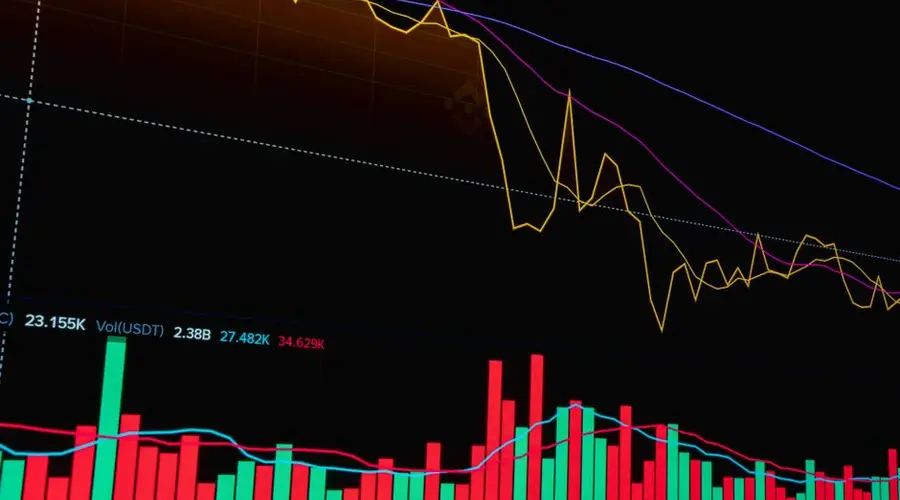
- Volume that stands out sharply against the recent average for that security, appearing as a visibly outsized bar on a volume chart.
- The spike occurring near the end of an already extended trend, rather than early in a move or in the middle of a range.
- Price action that reflects urgency, a wide-range bar, a sharp intraday reversal, or a gap, consistent with participants reacting emotionally rather than gradually.
Consider an illustrative scenario: a stock has been declining for weeks on ordinary volume. On one session, the decline accelerates, volume comes in several multiples above the recent average, and the session closes well off its lows after opening sharply lower. Traders watching for a selling climax would note the outsized volume and the intraday reversal as consistent with capitulation, the point where sellers who had been holding through the decline finally sold, exhausting near-term selling pressure. The mirror scenario, a stock that's rallied for weeks, then spikes on extreme volume with a wide range near the top of an extended move, is the pattern traders associate with a buying climax.
How Traders Read Climax Volume
Treat it as a flag, not a signal
An outsized volume bar at the end of a trend is generally treated as a reason to pay closer attention, not as an automatic entry or exit trigger. The spike itself only describes what already happened during that bar, it doesn't guarantee what happens next.
Watch subsequent price behavior
Because a genuine climax is defined partly by its aftermath, traders typically wait to see whether price fails to extend the prior trend on reduced volume in the following sessions, and whether it can hold above (for a selling climax) or below (for a buying climax) the climax bar's range. A quick failure to hold that level is often read as evidence the spike wasn't truly exhaustive.
Combine with trend and other volume context
Climax volume is usually considered alongside the broader trend structure and other volume-based tools, rather than in isolation. A large volume spike that occurs mid-trend, without an already extended move behind it, is less commonly read as a climax than one occurring after a long, one-directional run.
Limitations and Common Mistakes
- Calling every large volume bar a climax, volume spikes can come from scheduled news, earnings, index rebalancing, or options expiration, not just trend exhaustion.
- Acting on the spike bar itself, because confirmation depends on what happens afterward, entering immediately on the volume spike skips the follow-through check that separates a real climax from a continuation event.
- Ignoring trend context, a volume spike in the middle of a range carries a different interpretation than one after a long, extended trend.
- Assuming a fixed volume multiple defines a climax, no standardized threshold exists, so labeling a bar a climax is a judgment call, not a precise calculation.
- Treating a climax as a guaranteed reversal, even a genuine exhaustion event only reduces the pool of remaining participants on one side; it doesn't guarantee price reverses immediately or holds a new direction.
A Label You Can Only Apply Afterwards
Climax volume has an awkward property at its centre: the definition depends on what happens next. A spike becomes a selling climax because the decline ended there. If price keeps falling, the same bar is a continuation event, and it looked exactly the same at the time. Using the concept in real time therefore means acting on a classification you are not yet in a position to make.
That argues for treating an outsized bar at the end of an extended move as a reason to watch more closely rather than as a trigger. What separates a genuine exhaustion event from a heavy continuation bar is the behaviour that follows it: whether price stops making new extremes, whether subsequent attempts in the old direction arrive on lighter volume, whether the range narrows. All of that takes time to appear.
There is also no threshold to lean on. No standard specifies how many times average volume a bar must reach to qualify, so calling something a climax is a judgment about context, not a calculation. The context that matters most is where in the trend the bar appears, since the same spike in the middle of a range means something entirely different from one after a long, extended move.
And be strict about alternative explanations. Scheduled news, earnings, index rebalancing and options expiry all produce extreme volume bars that have nothing to do with participant exhaustion. Ruling those out first is what keeps the label meaningful.
Climax Volume FAQs
What is climax volume?
Climax volume is an extreme spike in trading volume, often occurring at the end of a sustained price move, associated with capitulation selling or euphoric buying as the last remaining holdouts finally act. It's commonly cited as a potential exhaustion signal marking the end of a trend.
What's the difference between a selling climax and a buying climax?
A selling climax happens near the end of a downtrend, when remaining holders capitulate and sell in a burst of extreme volume, potentially exhausting further selling pressure. A buying climax happens near the end of an uptrend, when euphoric buying pulls in the last hesitant buyers at extreme volume, potentially exhausting further buying pressure.
Does climax volume always mark the end of a trend?
No. A volume spike only becomes a confirmed climax in hindsight, once price behavior afterward shows the prior trend has actually stalled or reversed. Many large volume spikes turn out to be continuation events rather than exhaustion, so labeling one a climax in real time is inherently uncertain.
How can traders try to confirm a climax volume signal?
Traders typically watch what happens after the spike rather than reacting to the spike alone, whether price fails to make a new extreme on reduced volume, whether it reverses and holds above (or below) the climax bar's range, and whether the broader trend structure starts to shift. Confirmation is a process over subsequent bars, not a single-bar read.
Is climax volume the same as a volume spike?
Every climax volume event is a volume spike, but not every volume spike is a climax. A volume spike can occur for many reasons, including scheduled news or index rebalancing. It's only described as climax volume when it occurs near the end of a sustained move and is associated with capitulation or euphoric participation.
Is there a numerical threshold for climax volume?
No standard one exists. Practitioners approximate it with a multiple of average volume, or as the highest volume in a lookback window, or by eye against the recent bars. Each produces a different set of bars. Because the concept also carries an implication about location within a move, a purely numerical definition captures only half of what the term is used to mean.
How does climax volume relate to the Wyckoff selling climax?
The Wyckoff event is more specific. A selling climax is not merely a high-volume bar: it is placed within a schematic, at the end of a decline, and is expected to be followed by an automatic rally that defines the range above it. Climax volume as a general term describes the volume characteristic alone, without the surrounding sequence that gives the Wyckoff event its meaning.
Can climax volume occur without a large price move?
Yes, and the configuration is distinctive: very heavy volume within a narrow range means substantial size changed hands without price travelling. In the effort-and-result language used in volume analysis, that is high effort with little result. It is read differently from a high-volume wide-range bar, and a definition based on volume alone treats them identically.
Does climax volume appear on a weekly chart?
Aggregation changes what is visible in both directions. A single climactic session can be averaged into an unremarkable weekly total, so the event disappears. A week containing several heavy sessions can produce a weekly volume figure that looks climactic without any individual session having been. The bar that carries the label depends on the aggregation, which the term itself does not specify.
References
Disclaimer
This page is for educational purposes only and does not constitute personalized investment advice. Climax volume is a descriptive pattern, not a guaranteed signal, and identifying one is inherently a judgment call that can only be confirmed with hindsight. It should not be used as the sole basis for a trading decision. Past volume and price behavior does not predict future results.