
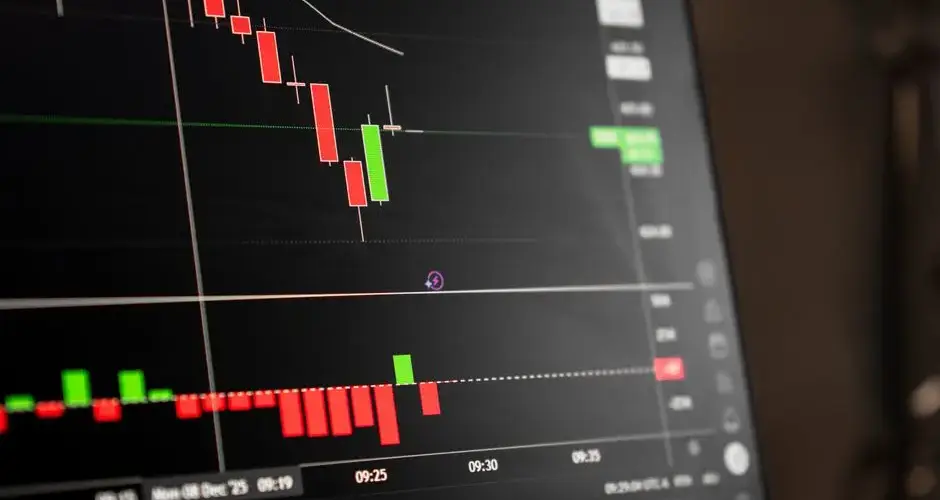
Direct Answer
A Short Bullish Candle is a one-bar pattern: the close finishes above the open, but only modestly, leaving a small green real body. It shows that buyers had the edge over the session, but not by a wide margin, the opposite of a Long Bullish Candle, where a long body reflects strong, decisive buying.
Key Takeaways
- A Short Bullish Candle is a single bar with a small green (bullish) real body, reflecting modest buying pressure over the session.
- On its own, it's a weak momentum signal rather than a named reversal pattern, its meaning depends heavily on where it appears and what surrounds it.
- After a sharp rally, a Short Bullish Candle can be a tentative sign that buying pressure is fading; mid-trend, it usually just reflects a quiet, lower-conviction session.
- It carries much less weight on its own than a Long Bullish Candle, which has a long real body and signals strong momentum.
- It is often confused with a Spinning Top, which shares a small body but has wicks on both sides, showing two-sided indecision rather than one-sided buying.
Short Bullish Candle Candlestick Pattern: Formation, Meaning, and Signals
A Short Bullish Candle is a single bar with a small green real body, showing modest buying pressure over the session. It is a weak momentum signal on its own, and its implication depends heavily on where it appears and what surrounds it, not on its shape alone.
What Is a Short Bullish Candle?
A Short Bullish Candle is a one-bar pattern: the close finishes above the open, but only modestly, leaving a small green real body. It shows that buyers had the edge over the session, but not by a wide margin, the opposite of a Long Bullish Candle, where a long body reflects strong, decisive buying.
Because the pattern is defined by a single bar with a small body. It is not treated as a named reversal signal the way multi-bar patterns are. Instead, it's read as a description of modest buying pressure for that one session, and traders lean on the surrounding trend and context to decide what, if anything, it implies about what comes next.
How a Short Bullish Candle Forms
A Short Bullish Candle forms whenever a single bar closes above where it opened, but the real body, the distance between open and close, stays small relative to a strong trending bar. The result is a green candle whose body is modest rather than dominant, which is what distinguishes it from a Long Bullish Candle's long, decisive real body.
Because it's a single-bar pattern, it carries no information beyond that one session's open-close relationship. The wicks, the surrounding trend, and the bars that follow all matter more for interpretation than the small body itself.
Short Bullish Candle Example
The chart below shows a deterministic, illustrative example: context leading in, a Short Bullish Candle forming, then two possible continuations, a confirmation and a failure/look-alike. Toggle between them to see why a small bullish body alone doesn't decide the outcome.
How to Trade a Short Bullish Candle
After a sharp rally
A Short Bullish Candle appearing after a sharp rally can signal that buying pressure is fading, a tentative bearish sign, since a small body after strong momentum suggests conviction is weakening rather than continuing to build.

Mid-trend
Appearing in the middle of an established trend, a Short Bullish Candle usually just reflects a quiet, lower-conviction session rather than any meaningful shift. Context, where it forms relative to the trend, is what determines how much weight to give it.
Weigh it against stronger signals
Because it carries much less weight on its own than a Long Bullish Candle, a Short Bullish Candle is best treated as a minor data point, not a standalone signal. Traders typically look for it to align with other context, trend location, nearby levels, or the bars that follow, before acting on it.
Common Short Bullish Candle Mistakes
- Reading a small green candle as meaningfully bullish on its own, small bodies generally carry less signal weight, not more.
- Ignoring the surrounding trend, the trend and level a Short Bullish Candle appears at is what actually determines its meaning, not the shape alone.
- Ignoring volume context, the same small body can reflect very different conditions depending on the activity behind it.
- Confusing it with a Spinning Top, a Short Bullish Candle shows one-sided (if modest) buying, while a Spinning Top shows two-sided indecision with wicks on both sides.
Short Bullish Candle vs. Similar Patterns
| Pattern | Body size | Key difference from a Short Bullish Candle |
|---|---|---|
| Short Bullish Candle | Small | Baseline, small body, weak/low-conviction bullish signal |
| Long Bullish Candle | Long | Long real body, signals strong momentum rather than a weak, low-conviction move |
| Spinning Top | Small | Small body with wicks on both sides, two-sided indecision, not one-sided (if modest) buying |
Limitations of the Short Bullish Candle Pattern
A Short Bullish Candle only describes one bar's open-close relationship, it does not by itself tell a trader whether buying pressure is building, fading, or simply pausing. It carries no information about volume, order flow, or the reasons behind the modest move, and it is not a named reversal pattern the way multi-bar setups are. Like any single-bar pattern, it works best combined with trend context and the bars that follow, not used alone.
A Small Body Is Mostly a Statement About the Range
A short green body says price finished modestly above where it opened. That is a small amount of information, and most of what it conveys is about the session being quiet rather than about buyers doing anything decisive. Treating it as a signal of any kind overstates a bar that mainly reports an absence of movement.
Where it becomes interesting is as a change from what came before. After a sharp rally, a short bullish candle is a pause in a market that had been covering ground quickly, and that contrast carries more meaning than the bar itself. In the middle of a quiet stretch it is one more quiet session.
The wicks are worth reading alongside the body, since a small body with long shadows describes an active two-sided session that ended near flat, while a small body with small wicks describes very little happening at all. The label covers both.
And short is relative. What counts as a small body depends on the recent range on that chart, which means the classification depends on a comparison window you chose rather than on the bar in isolation.
Short Bullish Candle FAQs
Is a Short Bullish Candle a strong bullish signal?
No. A Short Bullish Candle is a single bar with a small real body, which reflects modest buying pressure over that session rather than a decisive move. It carries much less weight on its own than a Long Bullish Candle.
What does a Short Bullish Candle after a sharp rally usually mean?
It can be a tentative sign that buying pressure is fading, since a small body after an extended up-move shows conviction weakening rather than strengthening. It is not a reversal signal by itself and needs further confirmation.
What does a Short Bullish Candle mean in the middle of a trend?
Appearing mid-trend, it usually just reflects a quiet, lower-conviction session rather than any meaningful shift in direction. Context, where it forms relative to the trend, determines how much weight to give it.
What's the difference between a Short Bullish Candle and a Spinning Top?
A Short Bullish Candle has a small green body showing modest one-sided buying pressure. A Spinning Top has a small body with wicks on both sides, reflecting two-sided indecision rather than one-sided, if modest, buying.
How is a Short Bullish Candle different from a Long Bullish Candle?
A Long Bullish Candle has a long real body and signals strong momentum, while a Short Bullish Candle has a small body and is a weak, low-conviction signal. The size of the real body is what separates the two.
How does a short bullish candle read after a gap up?
The gap did the work and the session did not. Price opened substantially higher and then went almost nowhere, which describes an initial repricing that neither extended nor reversed. That is a different situation from a small body after a flat open, and the candle alone does not distinguish them since the body records only the distance between open and close.
Does shadow length change what a short bullish candle means?
Considerably, and long shadows move the bar into a different named category. A small body with long shadows on both sides is a spinning top or a high wave candle; with a long lower shadow it approaches a hammer. The short bullish candle description implicitly assumes modest shadows, and a definition that only tests body size will collect all of these together.
Do short bullish candles mean the same thing on every timeframe?
They occur at every scale and record different things. A short body on a one-minute chart is unremarkable and mostly reflects the tick size. On a weekly chart it means five sessions ended within a small distance of where they began, which can conceal a great deal of movement. The same shape summarises very different amounts of activity.
What does a run of short bullish candles describe?
A slow grind higher, where each session adds a little and none does much. That is a recognisable market condition with its own characteristics: low volatility, gradual progress, and a structure that offers few reference levels because no session created a meaningful high or low. It is the opposite of the momentum sequence that a run of long candles describes.
References
- CMT Association: Technical Analysis Body of Knowledge and Research
- CFA Institute Research and Policy Center: Investment Research
- Steve Nison, Japanese Candlestick Charting Techniques (1991), the book credited with popularizing Japanese candlestick analysis in Western markets.
- SEC Investor.gov: Introduction to Investing