
Direct Answer
A long-legged doji shares the same core definition as any doji: the open and close land close enough together that the candle's body collapses into a thin line near the middle of the range. What sets it apart is the wicks, on a long-legged doji, both the upper and lower wick extend unusually far beyond a typical doji's wick length, showing that price traveled well away from the open in both directions before settling back near it.
Key Takeaways
- A long-legged doji is a doji variant with unusually long wicks on both sides of the bar, well beyond a typical doji's wick length.
- The open and close remain near-equal and sit close to the middle of the range, even though price traveled a long way in both directions during the bar.
- It shows an especially wide intrabar battle that still ended in a near-even standoff, making it a more extreme statement of indecision than an ordinary doji.
- The wide range shows real two-sided conviction, not just a quiet non-event, so this pattern is often watched more closely at significant levels than a narrow-range doji in the same spot.
- Like any doji, it still requires next-bar confirmation before being treated as an actionable signal, the wick length alone doesn't indicate direction.
Long-Legged Doji Candlestick Pattern: Formation, Meaning, and Signals
A long-legged doji is a doji variant with unusually long wicks on both sides of the bar, while the open and close remain near-equal close to the middle of the range. It shows an especially wide intrabar battle, price traveled a long way in both directions, that still ended in a near-even standoff, making it a more extreme statement of indecision than an ordinary doji.
What Is a Long-Legged Doji?
A long-legged doji shares the same core definition as any doji: the open and close land close enough together that the candle's body collapses into a thin line near the middle of the range. What sets it apart is the wicks, on a long-legged doji, both the upper and lower wick extend unusually far beyond a typical doji's wick length, showing that price traveled well away from the open in both directions before settling back near it.
That combination, a wide total range with a near-equal open and close sitting near the middle, describes a bar where both buyers and sellers pushed hard and neither held the advantage by the close. It's read as an especially forceful version of indecision: not a quiet, narrow-range pause, but a bar where real two-sided conviction canceled itself out.
How a Long-Legged Doji Forms
Like any doji, a long-legged doji requires the open and close to be near-equal, positioned close to the middle of the bar's range rather than skewed toward the top or bottom. What distinguishes it from an ordinary doji is the length of the wicks on both sides: rather than short or moderate wicks, both the upper and lower wick extend well beyond a typical doji's wick length.

The result is a bar with a wide high-to-low range but a near-zero body positioned near the center of that range. This differs from a dragonfly or gravestone doji, where the open/close sits near one end of the range rather than the middle, a long-legged doji keeps the open/close centered while stretching the wicks on both sides.
Long-Legged Doji Example
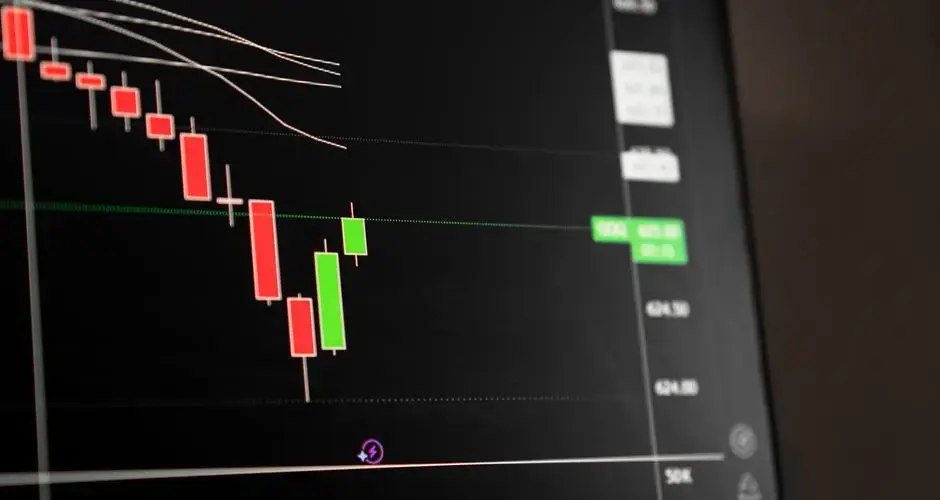
The chart below shows a deterministic, illustrative example: a trend leading in, a long-legged doji forming with its wide wicks on both sides, then two possible continuations, a confirmation (price follows through beyond the pattern's range) and a failure/look-alike (price breaks the opposite side instead). Toggle between them to see why the wick length alone doesn't decide the outcome.
How to Trade a Long-Legged Doji
Weigh the wide range as conviction, not direction
Because the wide range shows real two-sided conviction on both sides, not just a quiet non-event, a long-legged doji at a significant level (support, resistance, or after an extended trend) is often watched more closely than a narrow-range doji in the same spot. The width of the range reflects how much both sides fought for control, not which side will ultimately win out.
Wait for confirmation regardless
Even at a significant level, a long-legged doji still requires next-bar confirmation before acting. The pattern only shows that the bar closed near where it opened after a wide round trip in both directions, it doesn't itself indicate which way price resolves next.
Common Long-Legged Doji Mistakes
- Treating the length of the wicks as itself a directional signal, it isn't. Long wicks on both sides just show the range was wide, not which way it will resolve.
- Skipping confirmation because the pattern looks visually dramatic, a wide-range bar still needs the same next-bar follow-through check as any other doji.
- Confusing it with a regular doji, a long-legged doji specifically has unusually long wicks on both sides, not just a near-zero body.
Long-Legged Doji vs. Similar Patterns
| Pattern | Body size | Key difference from a long-legged doji |
|---|---|---|
| Long-Legged Doji | Near zero, near the middle | Baseline, unusually long wicks on both sides of a near-equal open/close |
| Doji (standard) | Near zero | Wicks are not required to be unusually long; a long-legged doji is a more extreme case |
| Spinning Top | Small but visible | Has a real (if small) body with wicks on both sides; less extreme indecision than a long-legged doji |
| Four-Price Doji | Zero range entirely | Open, high, low, and close are all equal, no wicks at all, the opposite extreme from a long-legged doji's wide range |
Limitations of the Long-Legged Doji Pattern
A long-legged doji describes one bar's open-close relationship and the width of its intrabar range, it doesn't indicate direction, volume, order flow, or the cause of the two-sided conviction behind it. A wide range can be driven by a scheduled news release, thin liquidity, or ordinary volatility, and the pattern alone can't distinguish between them. Like any single-bar pattern, it works best combined with trend context, support/resistance, and a defined confirmation and invalidation plan, not used alone.
A Wide Range Is Not Always a Battle
The standard reading is an especially wide two-sided fight that ended level, and that is one explanation for the shape. Another is thin liquidity, where a small number of orders push price a long way in both directions without much conviction on either side. A third is a scheduled release that moved price sharply and then unwound. All three produce long wicks either side of a near-equal body, and the candle cannot distinguish them.

Checking volume separates the first from the second most of the time. A wide two-sided session on heavy participation is a genuine disagreement; the same shape on light volume is closer to noise given room to move.
There is a practical consequence to the width. Any stop derived from the bar own extremes sits a long way from the close, so a position taken on this pattern carries a wide invalidation and has to be sized accordingly. That cost is part of the pattern rather than an afterthought.
And it points nowhere by itself. The bar records a wide fight ending near even, which is a statement about the session rather than about what follows, and the resolution can come in either direction or not at all.
Long-Legged Doji FAQs
Is a long-legged doji more significant than a regular doji?
It shows a wider intrabar range, meaning price traveled further in both directions before settling back near its open, a more extreme statement of indecision. That makes it more visually dramatic, but it still requires the same next-bar confirmation as any other doji before being treated as a signal.
Do the long wicks on a long-legged doji point to a direction?
No. Long wicks on both sides show that the range was wide, not which way price will resolve next. The pattern describes a wide two-sided battle that ended near a standoff, not a directional forecast.
What's the difference between a long-legged doji and a regular doji?
Both have a near-zero body with the open and close nearly equal. A long-legged doji adds unusually long wicks on both sides of that near-equal open and close, well beyond a typical doji's wick length, showing a wider intrabar range.
Does a long-legged doji need confirmation?
Yes. Despite its dramatic wick length, a long-legged doji only shows that the bar closed near where it opened. Traders typically wait for the next bar to close beyond the pattern's high or low before treating it as an actionable signal.
How is a long-legged doji different from a spinning top?
A long-legged doji has a near-zero body, the open and close are nearly identical. A spinning top has a small but visible real body with wicks on both sides, making it a less extreme form of indecision than a long-legged doji.
Does the position of the body within the range matter?
It does for the reading, though not for the definition. A doji body sitting at the centre of a long range describes a session that swung both ways and settled in the middle. One sitting near the top or bottom of the range describes a session that recovered or gave back most of its movement. All three qualify as long-legged dojis and they record quite different sessions.
Can a long-legged doji form on a weekly bar?
Yes, and it hides a great deal. A week that opened and closed at essentially the same price after ranging widely can contain a sustained advance and an equal decline, or several reversals, and the weekly candle shows none of that. The shape is a summary of a week that went nowhere in net terms, which is compatible with almost any internal path.
Do long-legged dojis cluster around particular events?
They appear disproportionately on days containing a scheduled announcement, since those sessions frequently produce a wide range as an initial reaction is absorbed and partly reversed. That gives a structural explanation for the shape, which is worth establishing before reading it as market indecision. The calendar is the quickest place to check.
What happens on a scanner that requires an exactly zero body?
It returns almost nothing in instruments quoted to several decimal places, because open and close coinciding to the last digit is rare. The pattern then appears to be absent from charts where the eye clearly sees it. Every practical implementation therefore uses a tolerance, and the strict version is useful mainly as a demonstration of how much the tolerance is doing.
References
- CMT Association: Technical Analysis Body of Knowledge and Research
- CFA Institute Research and Policy Center: Investment Research
- Steve Nison, Japanese Candlestick Charting Techniques (1991), the book credited with popularizing Japanese candlestick analysis in Western markets.
- SEC Investor.gov: Introduction to Investing