
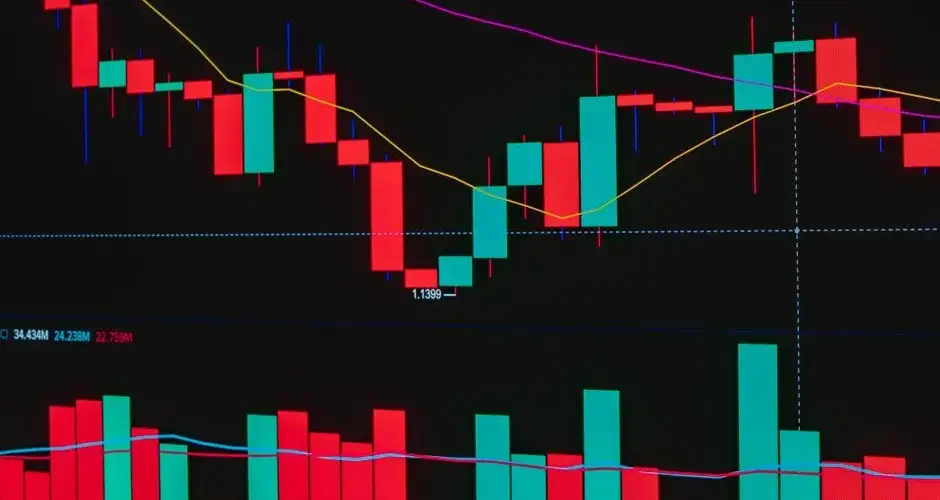
What Is a Volume Spike?
A volume spike is a single trading period whose volume is substantially higher than the security's recent average, often several multiples above normal. Spikes commonly coincide with news events, earnings, index rebalancing, or large institutional orders, which is why analysts typically investigate the cause of a spike rather than treating the elevated volume alone as a directional signal.
Direct Answer
A volume spike is a single trading period whose volume is substantially higher than the security's recent average, often several multiples above normal. Spikes commonly coincide with news events, earnings, index rebalancing, or large institutional orders, which is why analysts typically investigate the cause of a spike rather than treating the elevated volume alone as a directional signal.
Key Takeaways
- A volume spike is defined relative to a security's own recent average volume, not a fixed number that applies across every stock or coin.
- Spikes are common around news events, earnings releases, index additions or deletions, and large institutional orders being worked into the market.
- Volume tells you how much trading activity occurred, it says nothing on its own about which direction that activity favored.
- The same size spike can mean very different things depending on where price closed, what the news was, and how the period unfolded.
- Analysts generally investigate the underlying cause of a spike rather than reacting to the spike in isolation.
- Volume spikes are usually read alongside price action, trend context, and support/resistance levels, not as a standalone signal.
How a Volume Spike Forms
Every trading period, a minute, an hour, a day, has a volume total: the number of shares or contracts (or, in crypto, coin units) that changed hands. Under normal conditions, volume in a given security tends to cluster around a fairly stable range period to period, shaped by its typical liquidity and the market's usual rhythm of activity. A volume spike happens when one period's total breaks well outside that normal range, standing out clearly against the recent average rather than blending into ordinary day-to-day variation.
There's no single, universally agreed threshold that separates "somewhat elevated" volume from a true spike, different traders and platforms draw the line differently. What matters conceptually is the relationship between the period's volume and the security's own recent baseline: a spike is meaningful because it's an outlier for that specific security, not because it crosses some fixed number that applies to every ticker.
Common Causes of Volume Spikes
Volume spikes rarely happen without a reason, even when the reason isn't immediately visible on a chart. A few recurring sources show up again and again:
- News events. Regulatory announcements, macroeconomic releases, or company-specific headlines can pull in a wave of new orders as traders react to information all at once.
- Earnings. Quarterly results and forward guidance routinely draw a burst of trading activity around the release, both from investors repositioning and from short-term traders responding to the surprise (or lack of one).
- Index rebalancing. When a security is added to, removed from, or reweighted within an index, funds that track that index need to buy or sell to match the new composition, often concentrated in a narrow window.
- Large institutional orders. A single large buyer or seller working a big position into the market, sometimes over one period, sometimes spread across several, can show up as a spike even absent any public news.
Because these causes look so different from one another, the same-sized spike can carry very different implications depending on which one produced it.
Why the Cause Matters More Than the Spike Itself
Consider a hypothetical: a stock that normally trades a modest, fairly steady volume suddenly trades several times that amount in a single session. Read in isolation, that's just "a lot happened." It could mean an index fund rebalancing forced a wave of buying that has little to do with the company's outlook. It could mean an earnings surprise triggered genuine repositioning by long-term holders. It could mean a large institutional seller is exiting a position gradually, with price barely moving because the order is being worked carefully. Or it could mean two roughly equal-sized groups of buyers and sellers disagreed sharply, producing heavy volume with the price ending close to where it started.
Each of those scenarios has a different implication for what might happen next, and none of them can be distinguished by the volume number alone. That's why volume spikes are best treated as a prompt to look further, checking the news calendar, the earnings schedule, index-rebalancing dates, and how price behaved during and after the spike, rather than as a standalone buy or sell trigger.
Limitations and Common Mistakes
- Treating any spike as automatically bullish. Heavy volume can just as easily accompany a sharp decline, or a session that ends flat after intense two-sided trading.
- Ignoring the cause. Reacting to the spike size without checking whether it lines up with news, earnings, or a rebalancing date skips the step that actually explains the activity.
- Using one fixed multiple across every security. A "big" volume day for a thinly traded stock can be an ordinary day for a heavily traded one; comparisons only make sense relative to that security's own recent average.
- Assuming the spike predicts direction. Volume measures participation, not which side controlled the period, that has to come from price action alongside the volume, not the volume alone.
- Forgetting spikes can be one-off events. A single unusual period, especially one tied to a known scheduled event like earnings or a rebalancing, may not signal any lasting shift in how the security normally trades.
The Spike Is the Question, Not the Answer
Start from the mechanical fact that makes volume non-directional: every share bought was sold by someone. A spike records that a large quantity changed hands, and it contains no information about which side was more motivated. Whatever directional read you take from a heavy session comes from price, from where the bar closed within its range, and from what the news was, never from the volume figure itself.

Which is why the cause matters more than the size. The same outsized bar could be an index fund rebalancing on a schedule that has nothing to do with the company, a genuine repositioning after an earnings surprise, or a single institutional order being worked through the book. Those three produce very different expectations for the following week, and the volume histogram renders them identically.
The comparison also has to be local. A day that would be extraordinary for a thinly traded name is unremarkable for a heavily traded one, so a fixed multiple applied across a watchlist will flag the illiquid names constantly and miss real activity in the liquid ones. Measure against the security own recent average.
The practical habit is simple: when a spike appears, go and find out what happened before deciding what it means. If you cannot identify a cause, that is itself worth knowing, and it argues for smaller conclusions rather than louder ones.
Volume Spikes FAQs
What counts as a volume spike?
There's no single fixed threshold. A volume spike is generally a period whose volume is substantially higher than the security's recent average, often described as several multiples above normal, rather than a specific universal number.
Is a volume spike bullish or bearish?
Neither by itself. Volume measures how much trading activity occurred, not which direction it favored. A spike can accompany a sharp rally, a sharp selloff, or a period that closes little-changed after heavy two-sided trading.
What usually causes a volume spike?
Common causes include news events, earnings releases, index rebalancing, and large institutional orders. Each leaves a different footprint, which is why analysts look into the cause rather than reacting to the elevated volume alone.
Should I trade every volume spike?
No. Treating a spike alone as a buy or sell signal skips the step that matters most, understanding why volume jumped. The same spike size can reflect very different underlying situations.
How is a volume spike different from relative volume?
Relative volume is an ongoing ratio comparing current volume to a historical average, typically tracked throughout a session. A volume spike is the specific, discrete event of one period's volume jumping far above that baseline.
Does a spike in one security say anything about its sector?
Checking whether peers spiked on the same session separates two very different situations. A spike confined to one name points to something specific to it. A spike across the sector points to a shared cause, in which case the individual chart is showing a group event. The check takes a moment and changes the interpretation entirely, and it is routinely skipped.
What is the difference between a volume spike and climax volume?
A spike is defined by the volume figure alone and can occur anywhere. Climax volume adds a requirement about location: it describes heavy volume occurring at the end of an extended move, where it is read as a possible exhaustion of the participants driving it. Every climax is a spike; most spikes are not climaxes, because most of them do not occur at the end of anything.
Can an index show a volume spike?
Index volume is an aggregate of its constituents, so a spike requires either broad participation across many members or an extraordinary move in a heavily weighted one. That makes index-level spikes rarer and more meaningful as breadth events than single-security spikes. It also means an index volume figure can look ordinary on a day when several constituents individually spiked.
How does a block trade appear in the volume figure?
As a single large print that lands in one bar, which can produce a spike with no change in the underlying pattern of ordinary trading. A negotiated cross between two parties reports as volume without having involved the order book at all. Where trade-level data is available, checking whether the session volume came from many trades or from one is the way to distinguish them.
References
This page is educational content, not personalized investment advice. Volume spikes describe historical trading activity; they do not predict future performance and should not be treated as a standalone recommendation to buy or sell any security.