
Direct Answer
Every daily bar has a high and a low that mark the full extent of that session's trading. An outside day compares those two numbers to the prior session's high and low: if today's high is above yesterday's high, and today's low is below yesterday's low, today's range has fully "engulfed" yesterday's.
Key Takeaways
- An outside day is a full trading day whose range exceeds the prior day's range on both the high and low side, its high prints above the prior high, and its low prints below the prior low.
- An outside day is directionally neutral by definition; it describes range expansion, not a guaranteed bullish or bearish outcome.
- An outside day is the volatility opposite of an inside day, whose range sits entirely inside the day before it.
- It overlaps with, but isn't identical to, a candlestick engulfing pattern, which is defined by the body (open/close) rather than the high/low.
- Most approaches read an outside day alongside where it forms in the broader trend and wait for the next day's close to confirm direction before acting.
Outside Day: A Daily Range-Expansion Pattern
An outside day is a daily-timeframe outside bar: a full trading day whose range exceeds the prior day's range on both the high and low side. The current session's high trades above the previous session's high, and its low trades below the previous session's low, so the newer bar's entire range engulfs the one before it, a visible jump in intraday volatility compressed into a single daily candle.
What Is an Outside Day?
Every daily bar has a high and a low that mark the full extent of that session's trading. An outside day compares those two numbers to the prior session's high and low: if today's high is above yesterday's high, and today's low is below yesterday's low, today's range has fully "engulfed" yesterday's. It's a two-day comparison, not a property of a single candle in isolation, the same bar could be an ordinary trading day if the prior session had been wider, or an outside day if the prior session had been narrower.
Because the definition only concerns the high and low, an outside day is direction-neutral on its own. What matters for traders is where the day opens and closes within that expanded range, and where the pattern sits relative to the trend leading into it.
How an Outside Day Forms
An outside day typically follows a narrower, often indecisive session, sometimes a small-range day, sometimes a session that itself looked like an inside day. That narrow prior day leaves both a nearby high and a nearby low that the market hasn't decisively broken. The outside day forms when a shift in supply and demand, a scheduled catalyst, an earnings release, a macro surprise, or simply a buildup of orders finally clearing, pushes price through both of those boundaries within a single session.
The close is what traders read most closely. An outside day that closes near its high, after also trading below the prior low, suggests sellers were tested and failed, often read as bullish. An outside day that closes near its low, after also trading above the prior high, suggests buyers were tested and failed, often read as bearish. An outside day that closes near the middle of its own range is more ambiguous and usually needs the next session to clarify.
Outside Day Example
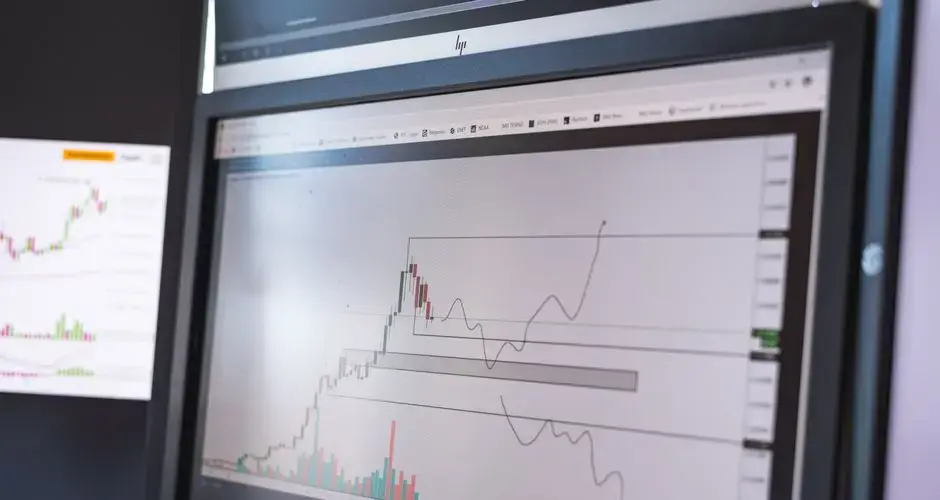
The chart below shows a deterministic, illustrative example: a narrow prior-day range followed by an outside day whose high and low both exceed it, closing near the low, a bearish-leaning outside day after an uptrend. Toggle between two possible continuations: a confirmation (the next sessions extend lower, following through on the bearish close) and a failure/look-alike (price reverses back up through the outside day's own high, undercutting the bearish reading).
How to Trade an Outside Day
Read the close, not just the range
The engulfing high/low is only the setup; the close inside that expanded range is what most traders use to lean bullish or bearish. A close near one extreme of the outside day's range is treated as more informative than a close in the middle, which is often left unread until the next session prints.

Weigh the trend it appears in
An outside day that forms after an extended move, especially one that closes against the direction of that prior trend, is generally read as a potential reversal signal. The same pattern forming in the middle of a choppy, range-bound stretch carries much less weight, range expansion inside chop is common and less meaningful.
Wait for the next session to confirm
Because the outside day itself only shows that both sides of the market were tested, not which side ultimately wins, many traders wait for the following day's close to confirm direction before acting, rather than entering on the outside day's own close.
Common Outside Day Mistakes
- Assuming every outside day is bullish or bearish by default, the pattern only describes range expansion; the close and surrounding trend determine any directional read.
- Ignoring where the outside day sits in the broader trend, the same range-expansion bar means very different things after a strong trend versus inside a choppy range.
- Trading the pattern on the close without waiting for confirmation, a close near one extreme can still be undone by the next session, especially in a middle-of-range close.
- Conflating an outside day with a candlestick engulfing pattern, see the comparison below; the two use different parts of the bar and don't always coincide.
Outside Day vs. Similar Patterns
| Term | What it measures | Key difference from an outside day |
|---|---|---|
| Outside day | Whether today's high/low both exceed the prior day's high/low | Baseline, pure range comparison between two consecutive daily bars |
| Inside day | Whether today's high/low both sit inside the prior day's high/low | The opposite volatility condition, range contraction rather than expansion |
| Bullish/bearish engulfing candle | Whether today's body (open/close) fully contains the prior candle's body | Uses the body, not the high/low; an outside day and an engulfing candle can overlap without being identical |
| Wide-range bar | Whether a single day's range is unusually large relative to recent average range | Measured against a rolling average range, not directly against the prior single day |
How This Differs from Outside Bar
Outside day is the daily-timeframe application of the broader outside bar concept, which applies to any chart period. What makes the daily case distinct isn't the range math, it's identical, but what a full trading session represents: a whole day's worth of order flow, news, and participation compressed into one candle, which is why traders weigh an outside day against the prior daily trend and typically wait for the next day's close before treating it as a reversal signal. Those trend-context and next-session-confirmation habits are specific to daily analysis and don't map cleanly onto, say, a 15-minute outside bar, where "the next session" isn't a meaningful unit. If you're working with intraday or weekly bars, or want the general definition without the daily-trading framing, see the Outside Bar page.
Limitations of Outside Day Analysis
An outside day is read purely from two consecutive daily ranges; it says nothing on its own about volume, the reason behind the move, or what happens in the sessions that follow. Because the definition is direction-neutral, treating every outside day as an automatic reversal signal misreads the pattern, the close, the trend context, and follow-through all carry more information than the range expansion alone. Like any single-pattern signal, it's best used alongside broader trend and level context rather than in isolation.
Where It Closed Matters More Than How Wide It Was
The width is what draws the eye and the close is what carries the information. An outside day that finishes near the top of its expanded range and one that finishes near the bottom are the same pattern by definition and opposite observations in practice, since one describes buyers absorbing a probe lower and the other describes sellers rejecting a probe higher. Reading the shape without the close leaves the directional half of the bar unused.
The trend the bar sits in supplies the rest of the meaning. The same range expansion after a long, extended move and inside a directionless range are different events, and the pattern definition is deliberately neutral about which.
Waiting for follow-through is the other habit worth keeping. A close within the expanded range is one bar of evidence, and acting on it without the next bars confirming means treating a single session as a conclusion.
Also note what two consecutive daily ranges cannot contain. There is no volume in the definition, no reason for the move, and no record of the order in which the high and low were made, so the pattern describes an outcome rather than what produced it.
Outside Day FAQs
What is an outside day?
An outside day is a daily-timeframe outside bar: a full trading day whose range exceeds the prior day's range on both the high and low side. The current day's high prints above the prior day's high, and its low prints below the prior day's low, so the newer bar's range fully engulfs the one before it.
Is an outside day bullish or bearish?
An outside day is directionally neutral by definition, it only describes range expansion, not which way price closes. Where the outside day closes relative to its own open and relative to the prior day's close determines whether traders read it as a bullish or bearish signal.
How is an outside day different from an inside day?
An inside day's entire range sits inside the prior day's range, its high is lower and its low is higher than the day before. An outside day is the opposite: its range exceeds the prior day's range on both sides. The two describe opposite volatility conditions, contraction versus expansion.
How is an outside day different from a bullish or bearish engulfing candle?
The two overlap but aren't identical. An outside day is defined purely by the high and low exceeding the prior day's range; a candlestick engulfing pattern is defined by the body (open and close) fully containing the prior candle's body. A single bar can qualify as one, both, or neither depending on where it opens and closes within its own expanded range.
Does an outside day guarantee a trend reversal?
No. An outside day shows that volatility expanded and that both sides of the market were tested within a single session, but it doesn't guarantee the subsequent direction. Traders typically wait for confirmation from the next day's close and consider where the outside day formed relative to the broader trend before treating it as a reversal signal.
Does an outside day require the open to be inside the previous range?
Some definitions add that condition, on the reasoning that a session which gapped beyond the prior range and then extended further is a gap event rather than a genuine engulfing of the previous day. Others require only the high and low condition. The stricter version is rarer and describes a session that covered the prior range from within, which is a different picture.
Do outside days cluster around scheduled events?
They occur disproportionately on days with a known catalyst, since new information tends to produce a session that extends beyond the previous day in at least one direction and often both. That makes an outside day on an announcement date substantially less informative than one occurring on an ordinary session, because the structural cause is already known.
How does an outside day affect average true range?
It raises it, and the effect persists for the length of the lookback. Because the bar range exceeds the previous day range by definition, an outside day always contributes an above-average value relative to its immediate neighbour. Any stop or band scaled to average true range therefore widens after an outside day and stays wider until the observation leaves the window.
Is an outside day the same as a wide-range bar?
No, and the reference point is what separates them. An outside day is defined relative to the single preceding bar, so it can be modest in absolute terms if that bar was narrow. A wide-range bar is defined relative to a distribution of recent ranges. A bar can be one without being the other in both directions.