
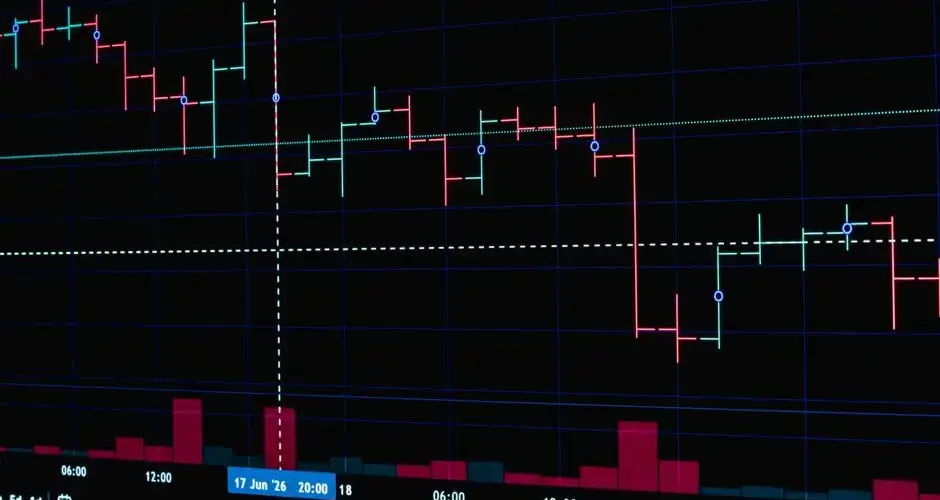
Direct Answer
A breakdown retest happens when price breaks below support, rallies back up to that same level, and is rejected there because the former support now acts as resistance. The bounce toward the level is not itself the signal: the pattern is only confirmed once the retest bars actually stall and turn lower at it. If price instead closes back above the broken level with follow-through, the breakdown retest reading is invalidated and the move looks more like a reclaim.
Key Takeaways
- A breakdown retest happens when price breaks below support, then bounces back up to that same level, which now acts as resistance, before turning lower again.
- The former support level tends to become resistance because traders who bought near it often sell into the bounce to limit losses, and traders who missed the breakdown may short the retest instead.
- The pattern isn't confirmed until the retest bar or bars actually stall and reverse at the level, price simply approaching the level from below isn't enough.
- If price closes back above the broken level with follow-through instead of reversing, the breakdown retest reading is invalidated and the move looks more like a reclaim.
- A breakdown retest is a specific version of the broader support-resistance role-reversal idea, applied to the bearish side of a broken level.
Breakdown Retest
A breakdown retest occurs after price breaks below a support level: rather than continuing straight down, price rallies back up to retest the broken level from below, where it now behaves as resistance, before rejecting and continuing lower. The retest is the pause traders watch for confirmation that the breakdown is genuine, not a false move.
What Is a Breakdown Retest?
Support and resistance levels aren't fixed walls, they're zones where buying or selling pressure has previously been strong enough to turn price around. When price finally breaks below a support level, that level doesn't simply disappear. Instead, it frequently flips roles: the same price area that once attracted buyers now attracts sellers, because traders who bought near the old support are looking to exit on any bounce, and traders who missed the initial breakdown see the bounce as a lower-risk entry to sell short.
A breakdown retest is the visible result of that role reversal: price breaks below support, pulls back up toward the broken level, and is rejected there before resuming the move lower. It's one of the most commonly referenced structures in price action trading precisely because it gives traders a second, more defined opportunity to act on a breakdown they may have missed the first time.
How a Breakdown Retest Forms
The pattern forms in three stages. First, price closes below a recognizable support level, establishing the breakdown. Second, price pulls back, sometimes over a single bar, sometimes over several, rising back toward the broken level from underneath. Third, price is rejected at or near that level and turns back down, often with a bearish close that leaves the retest as a local high.
Not every bounce after a breakdown qualifies as a clean retest. The more precisely price returns to the former support level (rather than stalling well below it or blowing straight through it), and the more clearly it's rejected there, the more traders treat the pattern as a confirmed signal rather than coincidence.
Breakdown Retest Example
The chart below shows a deterministic, illustrative example: price tests a support level twice, then a breakdown bar closes below it. A pullback of one or two bars carries price back up toward the broken level from below, followed by a rejection bar that turns back down. Toggle between two possible continuations: a confirmation (price is rejected and the downtrend resumes) and a failure/look-alike (price reclaims the level and closes back above it instead).
How to Trade a Breakdown Retest
Confirm the original breakdown first
A breakdown retest only means something if the initial break below support was itself a meaningful move, a close below the level, not just an intraday wick. Support tested and defended multiple times before it finally breaks tends to produce a more significant, more widely watched breakdown than a level that barely held to begin with.

Wait for the rejection, not just the approach
Price approaching the broken level from below is not, by itself, a signal, it's only the setup. Most traders wait for a bearish close at or near the level, ideally with some volume or momentum evidence of selling, before treating the retest as rejected rather than still in progress.
Define invalidation before the retest completes
A common invalidation point is a confirmed close back above the broken support level with follow-through in the next bar or two. Deciding on that invalidation level before the retest bar closes, rather than after, keeps the rule from being bent in hindsight.
Common Breakdown Retest Mistakes
- Selling the instant price touches the old level, entering before any rejection is confirmed risks trading a retest that turns into a reclaim instead.
- Treating every post-breakdown bounce as a retest, a shallow, brief bounce that never reaches the broken level isn't the same pattern and shouldn't be read as one.
- Ignoring how well-defended the original support was, a retest of a level that was only briefly support carries less weight than a retest of a level that held for a long time before breaking.
- Confusing a breakdown retest with a false breakdown, see the comparison below; the two patterns share the same setup but resolve in opposite directions.
Breakdown Retest vs. Similar Patterns
| Term | What it emphasizes | Key difference from a breakdown retest |
|---|---|---|
| Breakdown retest | Broken support tested from below, then rejected | Baseline, price returns to the broken level and is rejected, confirming the breakdown continues |
| Support/resistance role reversal | The general principle that a broken level can switch roles | The broader concept a breakdown retest is one specific, bearish-side application of |
| False breakdown | A breakdown that fails to hold | Price reclaims the broken level and closes back above it instead of being rejected there |
| Liquidity sweep | Resting orders clustered beyond a level | Focuses on the initial move through the level triggering stops, not the later retest of it |
Limitations of Breakdown Retest Analysis
A breakdown retest is read from price and level structure alone; it does not reveal the actual orders or participants behind the bounce, so it can't be treated as certain confirmation of continued selling. It also carries no guarantee, a level that has produced clean retests in the past can simply be reclaimed the next time. Like any single pattern, it works best combined with trend context, the credibility of the original support level, and a defined confirmation and invalidation plan, not used in isolation.
The Bounce Is the Test, and It Can Pass
The bounce back into broken support is not the pattern completing, it is the pattern being examined. Price returning to the level is expected; what matters is whether the old support turns it away or gets reclaimed. Treating the arrival as the signal means entering short into a level that has not yet demonstrated it holds, and a reclaim converts the whole sequence into a failed breakdown.

So the observable event is the rejection, not the retest. That distinction costs a worse entry price and removes the version of this trade where you are positioned against a level that has stopped being resistance.
The mechanism usually given is that buyers who were positioned near the old support sell into the bounce to limit losses, and traders who missed the breakdown use the retest to enter short. That is an inference about order flow drawn from repeated behaviour rather than something visible on the chart, and it explains why the effect is stronger at levels that were widely watched.
A level that has produced clean retests before can also simply be reclaimed the next time. Past retests are not evidence about this one, which is why the invalidation price matters more than the pattern history.
Breakdown Retest FAQs
What is a breakdown retest?
A breakdown retest happens when price breaks below a support level and then moves back up to retest that broken level from below, where it now acts as resistance, before continuing lower.
Why does broken support turn into resistance?
Once support breaks, traders who bought near that level often look to sell on any bounce back to it to limit their losses, and traders who missed the initial breakdown may use the level as a new entry for short positions. That selling pressure is what tends to turn the former support into resistance.
How is a breakdown retest different from a failed breakdown?
In a breakdown retest, price returns to the broken level and is rejected, continuing in the direction of the original breakdown. In a failed breakdown, price reclaims the broken level and closes back above it, invalidating the bearish move entirely, the two patterns look similar until the retest bar closes.
How do traders confirm a breakdown retest before entering a trade?
Most traders wait for the retest bar or bars to stall or reverse at the former support level, ideally with a bearish close and some volume or momentum evidence, before treating the pattern as confirmed. Entering purely because price approaches the level, before it actually rejects, risks trading a retest that turns into a reclaim instead.
What invalidates a breakdown retest?
If price closes back above the broken support level with follow-through, rather than stalling and reversing there, the breakdown retest reading is invalidated and the move is better read as a reclaim or a false breakdown.
Does the retest have to reach the exact level?
It rarely does, which is why a tolerance has to be defined before the setup can be recognised consistently. Price commonly stops short of the level or overshoots it slightly. Expressing the tolerance as a fraction of average true range keeps it proportionate to the instrument. Without a stated tolerance, whether a retest occurred becomes a judgement made after seeing what happened next.
Can a retest occur without price returning to the level?
A shallow bounce that stalls well below the broken level is sometimes described as a failure to retest, and it is a different observation from a completed retest. It means the level was never re-approached, so nothing was tested. Whether that is read as weakness or simply as an absence of information depends on the framework, and it should not be counted as a retest that held.
Where does the invalidation sit for a retest entry?
Above the broken level, because the entire premise is that the level now caps price from below. A close back above it means the breakdown has been reversed and the structure that justified the position no longer exists. How far above depends on the tolerance chosen for the level itself, which links the invalidation distance directly to how the zone was framed.
Does a retest work differently when the breakdown gapped through the level?
Yes, because the level was never traded through. In an ordinary breakdown, price passes the level in continuous trading and participants transact on both sides of it. A gap skips that entirely, so the first interaction with the level from below is the retest itself. There is less prior trading around it, which means less of the accumulated positioning the retest logic usually appeals to.