
Direct Answer
The IRA contribution limit for 2026 is $7,500 ($8,600 with catch-up for those age 50 or older, including the $1,100 indexed catch-up). This combined limit applies to all your IRAs together, traditional and Roth. The limit was $7,000 in 2024 and 2025, and $6,000 from 2019 through 2022.
IRA Contribution Limits by Year
IRA contribution limits by year (2002-2026)
The same dollar limit applies to both traditional and Roth IRAs, combined. The catch-up contribution for savers age 50 or older was a fixed $1,000 from 2006 through 2025. Under SECURE 2.0, the catch-up became indexed to inflation starting with tax year 2024; the first actual increase took effect in 2026, raising it to $1,100.
| Year | Contribution Limit | Catch-up (Age 50+) | Total with Catch-up |
|---|---|---|---|
| 2002 | $3,000 | $500 | $3,500 |
| 2003 | $3,000 | $500 | $3,500 |
| 2004 | $3,000 | $500 | $3,500 |
| 2005 | $4,000 | $500 | $4,500 |
| 2006 | $4,000 | $1,000 | $5,000 |
| 2007 | $4,000 | $1,000 | $5,000 |
| 2008 | $5,000 | $1,000 | $6,000 |
| 2009 | $5,000 | $1,000 | $6,000 |
| 2010 | $5,000 | $1,000 | $6,000 |
| 2011 | $5,000 | $1,000 | $6,000 |
| 2012 | $5,000 | $1,000 | $6,000 |
| 2013 | $5,500 | $1,000 | $6,500 |
| 2014 | $5,500 | $1,000 | $6,500 |
| 2015 | $5,500 | $1,000 | $6,500 |
| 2016 | $5,500 | $1,000 | $6,500 |
| 2017 | $5,500 | $1,000 | $6,500 |
| 2018 | $5,500 | $1,000 | $6,500 |
| 2019 | $6,000 | $1,000 | $7,000 |
| 2020 | $6,000 | $1,000 | $7,000 |
| 2021 | $6,000 | $1,000 | $7,000 |
| 2022 | $6,000 | $1,000 | $7,000 |
| 2023 | $6,500 | $1,000 | $7,500 |
| 2024 | $7,000 | $1,000 | $8,000 |
| 2025 | $7,000 | $1,000 | $8,000 |
| 2026 | $7,500 | $1,100 | $8,600 |
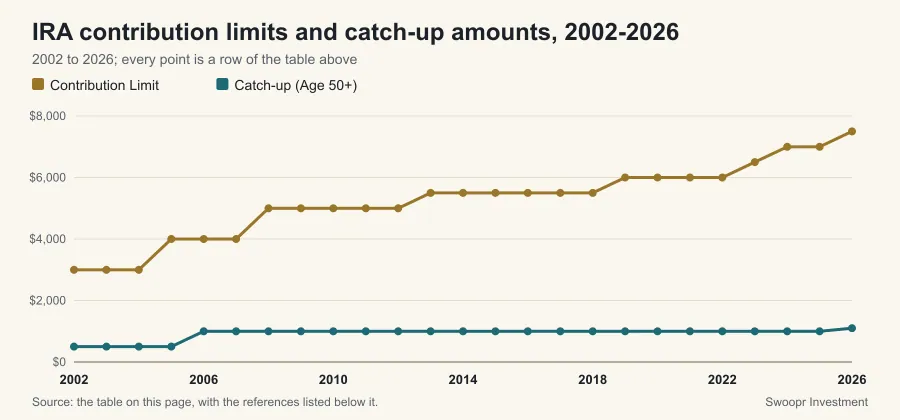
Source: IRS: IRA Deduction Limits. Last verified: September 2026. Verify current-year figures at IRS.gov before making decisions.
Key rules
The limit applies to combined contributions across all your IRAs. You cannot contribute more than your earned income for the year. The contribution deadline is the tax filing deadline (typically April 15) of the following year.
Frequently asked questions
What is the IRA contribution limit for 2026?
The IRA contribution limit for 2026 is $7,500 for those under age 50, or $8,600 for those age 50 or older (including the $1,100 indexed catch-up). This limit applies to the combined total across all your IRAs. If you contribute $4,000 to a Roth IRA, you may contribute up to $3,500 more to a traditional IRA in the same year.
Can I contribute to both a traditional IRA and a Roth IRA in the same year?
Yes. You can contribute to both types in the same tax year, but your combined contributions across all IRAs cannot exceed the annual limit of $7,500 (or $8,600 if age 50 or older in 2026). Income limits apply separately to Roth IRA contributions and to the deductibility of traditional IRA contributions.
Why did IRA limits stay flat from 2019 to 2022?
The IRA limit stayed at $6,000 from 2019 through 2022 because the IRS adjusts limits only when cumulative inflation warrants a $500 increment. Low inflation during 2019-2021 kept the limit unchanged. When inflation surged in 2022, the $500 increment was triggered for 2023, raising the limit to $6,500, and again for 2024 to $7,000.
Cite This Page
If you reference this table in your own work, use the following citation format and add the date you accessed it:
Swoopr Editorial Team. (2026). IRA Contribution Limits by Year. Swoopr Investment. https://www.getswoopr.com/tables/retirement/ira-contribution-limits/
Check the figures against the primary sources listed under References before you rely on or republish them; the series they come from are revised.