
Direct Answer
The 403(b) employee elective-deferral limit for 2026 is $24,500. Participants age 50 or older can add a general catch-up of $8,000. Participants ages 60 through 63 can use the higher SECURE 2.0 catch-up of $11,250 instead of the general age-50+ catch-up. Employees with 15 or more years of service with the same eligible employer may qualify for an additional special 403(b) catch-up of up to $3,000 per year (lifetime max $15,000). The Section 415(c) annual-additions limit is $72,000 for 2026.
403(b) Contribution Limits by Year
403(b) contribution limits by year (2015-2026)
| Year | Employee Deferral | Catch-up (Age 50+) | Special 15-Year Catch-up | Sec. 415 Limit |
|---|---|---|---|---|
| 2015 | $18,000 | $6,000 | Up to $3,000 | $53,000 |
| 2016 | $18,000 | $6,000 | Up to $3,000 | $53,000 |
| 2017 | $18,000 | $6,000 | Up to $3,000 | $54,000 |
| 2018 | $18,500 | $6,000 | Up to $3,000 | $55,000 |
| 2019 | $19,000 | $6,000 | Up to $3,000 | $56,000 |
| 2020 | $19,500 | $6,500 | Up to $3,000 | $57,000 |
| 2021 | $19,500 | $6,500 | Up to $3,000 | $58,000 |
| 2022 | $20,500 | $6,500 | Up to $3,000 | $61,000 |
| 2023 | $22,500 | $7,500 | Up to $3,000 | $66,000 |
| 2024 | $23,000 | $7,500 | Up to $3,000 | $69,000 |
| 2025 | $23,500 | $7,500 | Up to $3,000 | $70,000 |
| 2026 | $24,500 | $8,000 / $11,250 (age 60-63) | Up to $3,000 | $72,000 |
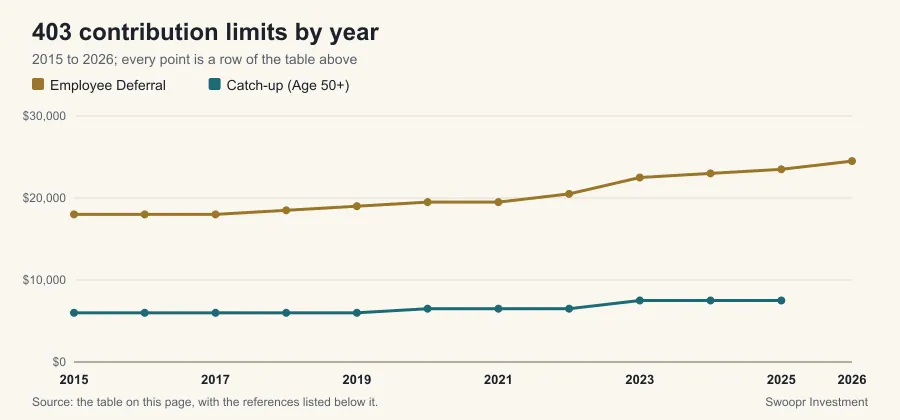
Source: IRS: IRC 403(b) Tax-Sheltered Annuity Plans. Last verified: September 2026. Verify current-year figures at IRS.gov before making decisions.
Special 15-year catch-up eligibility
The 15-year special catch-up is available to employees with at least 15 years of service with the same employer who have contributed less than $5,000 per year on average in prior years. The employer must confirm eligibility. This catch-up is applied before the age-50 catch-up, up to a lifetime maximum of $15,000. Not all 403(b) plans allow this provision.
Frequently asked questions
What is the 403(b) employee contribution limit for 2026?
The basic 2026 elective-deferral limit is $24,500. This is the ordinary employee salary-deferral ceiling before applicable catch-up contributions.
What is the 403(b) catch-up contribution for 2026?
The general catch-up for eligible participants age 50 or older is $8,000. For participants ages 60 through 63, the higher SECURE 2.0 catch-up is $11,250 for 2026. These are not cumulative: the age-60-63 catch-up replaces the general age-50+ catch-up for eligible participants in that age band.
Is the 403(b) limit the same as the 401(k) limit?
The basic employee elective-deferral limit is the same for 401(k) and 403(b) plans in 2026: $24,500. Important plan-specific rules still differ, including the 403(b) 15-year service catch-up.
How is a 403(b) different from a 401(k)?
A 403(b) is a defined contribution plan for employees of public schools, nonprofits, hospitals, and certain churches. The contribution limits, catch-up provisions, and tax treatment are virtually identical to a 401(k). One distinction is the 15-year special catch-up rule available to 403(b) participants with 15 or more years of service with the same employer.
What is the 15-year catch-up for 403(b) plans?
Employees with at least 15 years of service with the same employer may be eligible for a special catch-up of up to $3,000 per year, up to a lifetime maximum of $15,000. This catch-up has ordering rules with the age-based catch-up, and the actual permitted amount depends on the employee's prior contribution history and plan terms. The employer must confirm eligibility.
Can I contribute to both a 403(b) and a 457(b)?
Potentially, yes. The 457(b) deferral limit is generally separate from the 402(g) limit shared by 401(k) and 403(b) deferrals. If your employer offers both a 403(b) and a governmental 457(b) plan, you may be able to defer the maximum to each independently. Eligibility, employer-plan design, compensation and other rules still matter.
Cite This Page
If you reference this table in your own work, use the following citation format and add the date you accessed it:
Swoopr Editorial Team. (2026). 403(b) Contribution Limits by Year. Swoopr Investment. https://www.getswoopr.com/tables/retirement/403b-contribution-limits/
Check the figures against the primary sources listed under References before you rely on or republish them; the series they come from are revised.