
Direct Answer
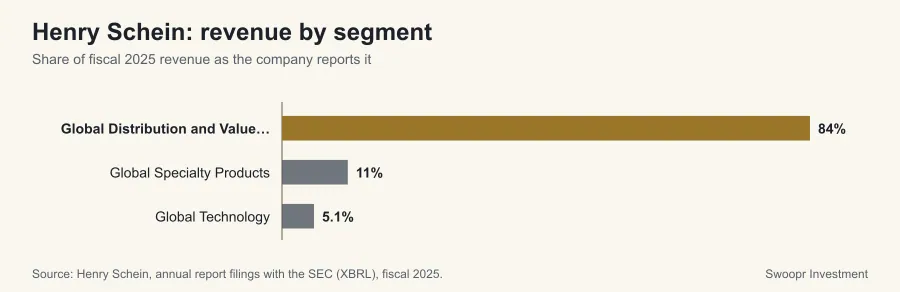
Henry Schein reports revenue across 3 business segments in its fiscal 2025 Form 10-K. Global Distribution and Value Added Services is the largest, with $11.1 billion of revenue (84% of the total), followed by Global Specialty Products at $1.4 billion (11%). 69% of revenue came from the United States.
How Does Henry Schein Make Money?
Global Distribution and Value Added Services supplies 84% of revenue, so Henry Schein's results move mostly with that one business; the others matter more for diversification than for the headline number. Between fiscal 2024 and 2025, Global Technology grew fastest (+7.1%) and Global Specialty Products slowest (-3.9%), so the revenue mix tilts toward Global Technology while that gap lasts.
| Segment | FY2025 revenue | FY2024 revenue | Share of revenue | Change |
|---|---|---|---|---|
| Global Distribution and Value Added Services | $11.1 billion | $10.7 billion | 84.5% | 3.8% |
| Global Specialty Products | $1.4 billion | $1.4 billion | 10.5% | -3.9% |
| Global Technology | $675 million | $630 million | 5.1% | 7.1% |
Which Henry Schein Segments Earn the Most?
| Segment | FY2025 segment operating income | Segment margin |
|---|---|---|
| Global Distribution and Value Added Services | $680 million | 6.1% |
| Global Specialty Products | $242 million | 17.4% |
| Global Technology | $180 million | 26.7% |
Segment operating income is the profit measure Henry Schein reports to its chief operating decision maker for each segment. It usually leaves out corporate costs that are not allocated to a segment, so the segments usually add up to more than consolidated operating income, and margins are comparable within Henry Schein more safely than against another company.
Where Does Henry Schein's Revenue Come From?
Regions follow the definitions in the filing; most companies assign revenue by customer location.
| Region | FY2025 revenue | FY2024 revenue | Share of revenue | Change |
|---|---|---|---|---|
| United States | $9.1 billion | $8.8 billion | 69.0% | 3.1% |
| Outside the United States | $4.1 billion | $3.8 billion | 31.0% | 6.2% |
What the Segment Figures Do Not Show
The rows above add up to 100% of Henry Schein's reported revenue for fiscal 2025; the difference is intersegment eliminations, corporate revenue or items the company reports outside its segments. Segment definitions are management's choice and change when a company reorganizes, in which case it restates prior years in the next filing, so a multi-year comparison should use the figures from a single filing. Revenue shows where sales come from, not where profit or cash is earned: a small segment can carry most of the margin.
Where These Numbers Come From
Every figure on this page is a value Henry Schein reported in the segment note and revenue disclosures of its Form 10-K filed February 24, 2026 (accession 0001000228-26-000013), read from the SEC's Financial Statement Data Sets. The prior-year column is the comparative figure from that same filing, so it reflects any restatement for a change in segments. Category names are the company's own XBRL labels, lightly reformatted for reading.
Rows that only total other rows (for example a "Products" line beside the individual products) are left out so nothing is counted twice. This page is educational and describes reported history for fiscal 2025; it is not a forecast or a recommendation.
Frequently Asked Questions
What are Henry Schein's business segments?
In its fiscal 2025 Form 10-K, Henry Schein reports revenue for Global Distribution and Value Added Services, Global Specialty Products and Global Technology.
Which part of Henry Schein brings in the most revenue?
Global Distribution and Value Added Services, with $11.1 billion of revenue in fiscal 2025, or 84% of the total.
How much of Henry Schein's revenue comes from outside the United States?
31% in fiscal 2025, by the geographic breakdown Henry Schein reports in its Form 10-K. Companies assign revenue to regions differently (customer location, shipping address or selling entity), so check the filing's definition before comparing companies.