
Direct Answer
If you or your spouse participate in a workplace retirement plan, your traditional IRA deduction phases out at certain income levels. For 2026, a single active participant phases out between $81,000 and $91,000 (2025: $79,000 to $89,000). A married couple where one spouse is an active participant phases out between $129,000 and $149,000 for that spouse (2025: $126,000 to $146,000). A non-participating spouse of an active participant phases out between $242,000 and $252,000 (2025: $236,000 to $246,000).
Traditional IRA Deductibility Income Limits
Active participant phase-out ranges (2015-2026)
These ranges apply when you are personally covered by a workplace retirement plan (401(k), 403(b), pension, SEP IRA, or SIMPLE IRA through your employer).
| Year | Single/HOH Begins | Single/HOH Ends | MFJ (Active) Begins | MFJ (Active) Ends |
|---|---|---|---|---|
| 2015 | $61,000 | $71,000 | $98,000 | $118,000 |
| 2016 | $61,000 | $71,000 | $98,000 | $118,000 |
| 2017 | $62,000 | $72,000 | $99,000 | $119,000 |
| 2018 | $63,000 | $73,000 | $101,000 | $121,000 |
| 2019 | $64,000 | $74,000 | $103,000 | $123,000 |
| 2020 | $65,000 | $75,000 | $104,000 | $124,000 |
| 2021 | $66,000 | $76,000 | $105,000 | $125,000 |
| 2022 | $68,000 | $78,000 | $109,000 | $129,000 |
| 2023 | $73,000 | $83,000 | $116,000 | $136,000 |
| 2024 | $77,000 | $87,000 | $123,000 | $143,000 |
| 2025 | $79,000 | $89,000 | $126,000 | $146,000 |
| 2026 | $81,000 | $91,000 | $129,000 | $149,000 |
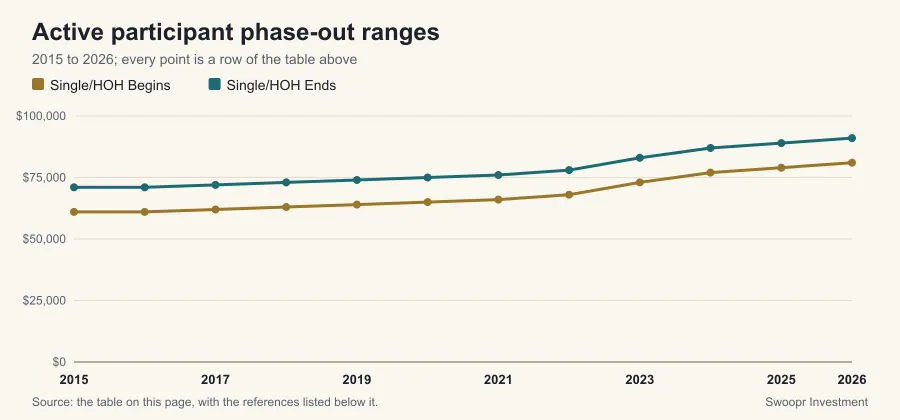
Source: IRS: 401(k) limit increases to $24,500 for 2026, IRA limit increases to $7,500 (Notice 2025-67) for 2026 figures, and IRS: 2025 IRA Deduction Limits - Effect of Modified AGI on Deduction If You Are Covered by a Retirement Plan at Work for 2025 figures. Last verified: October 2026. Verify current-year figures at IRS.gov before making decisions.
Non-participating spouse phase-out (2026)
If you are NOT covered by a workplace plan but your spouse is, a different (higher) phase-out applies to you: $242,000 to $252,000 MAGI (married filing jointly) for 2026. Below $242,000, you can fully deduct your IRA contribution regardless of your spouse's plan. For 2025, the range was $236,000 to $246,000.
Frequently asked questions
Can I deduct my traditional IRA if I have a 401(k)?
The deductibility depends on your income. If you are covered by a workplace retirement plan and your MAGI exceeds the phase-out range, your traditional IRA contribution is non-deductible. You can still make the contribution; growth is tax-deferred, and you track cost basis on Form 8606 each year.
What if only my spouse has a workplace plan?
If you are not covered by a workplace plan but your spouse is, a separate phase-out applies to you. For 2026, your deduction phases out between $242,000 and $252,000 of combined household MAGI. Below $242,000, you can fully deduct your IRA regardless of your spouse having a plan. For 2025, the range was $236,000 to $246,000.
Is a non-deductible IRA contribution still worth making?
A non-deductible traditional IRA contribution still grows tax-deferred, and you can potentially convert it to a Roth IRA. However, if you have existing pre-tax IRAs, the pro-rata rule taxes a portion of any conversion. Evaluate whether the tax-deferral benefit outweighs the complexity of tracking basis on Form 8606 each year.
Cite This Page
If you reference this table in your own work, use the following citation format and add the date you accessed it:
Swoopr Editorial Team. (2026). Traditional IRA Deductibility Income Limits. Swoopr Investment. https://www.getswoopr.com/tables/retirement/traditional-ira-deductibility-limits/
Check the figures against the primary sources listed under References before you rely on or republish them; the series they come from are revised.