
Direct Answer
The federal estate tax exemption for 2026 is $15,000,000 per person (about $30,000,000 per married couple with portability), up from $13,990,000 in 2025. The Tax Cuts and Jobs Act roughly doubled the exemption in 2018. The One Big Beautiful Bill Act (Pub. L. 119-21) set the 2026 amount and made the higher exemption permanent, indexed for inflation after 2026, so the sunset once scheduled after 2025 no longer applies.
Estate Tax Exemption and Rate History
Federal estate tax exemption and top rate by year (2001-2026)
| Year | Exemption | Top Rate |
|---|---|---|
| 2001 | $675,000 | 55% |
| 2002 | $1,000,000 | 50% |
| 2003 | $1,000,000 | 49% |
| 2004 | $1,500,000 | 48% |
| 2005 | $1,500,000 | 47% |
| 2006 | $2,000,000 | 46% |
| 2007 | $2,000,000 | 45% |
| 2008 | $2,000,000 | 45% |
| 2009 | $3,500,000 | 45% |
| 2010 | Repealed (opt-in available) | 0% / 35% opt-in |
| 2011 | $5,000,000 | 35% |
| 2012 | $5,120,000 | 35% |
| 2013 | $5,250,000 | 40% |
| 2014 | $5,340,000 | 40% |
| 2015 | $5,430,000 | 40% |
| 2016 | $5,450,000 | 40% |
| 2017 | $5,490,000 | 40% |
| 2018 | $11,180,000 | 40% |
| 2019 | $11,400,000 | 40% |
| 2020 | $11,580,000 | 40% |
| 2021 | $11,700,000 | 40% |
| 2022 | $12,060,000 | 40% |
| 2023 | $12,920,000 | 40% |
| 2024 | $13,610,000 | 40% |
| 2025 | $13,990,000 | 40% |
| 2026 | $15,000,000 | 40% |
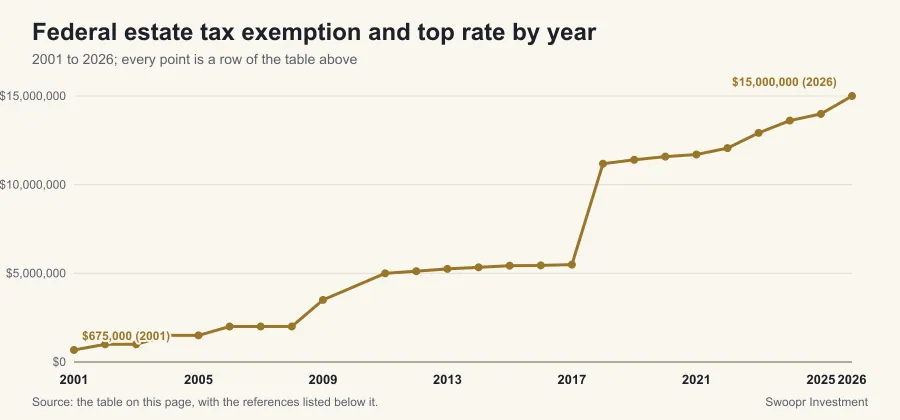
Source: IRS: Rev. Proc. 2025-32 (section 4.42) and IRS: Estate Tax. Last verified: October 2026. Verify current-year figures at IRS.gov before making decisions.
The TCJA sunset and the 2025 law
The Tax Cuts and Jobs Act (2017) roughly doubled the exemption from approximately $5.5 million to $11.18 million per person, effective for deaths on or after January 1, 2018. That increase was written to expire after December 31, 2025, which would have returned the exemption to about $7 million (the 2017 base of $5 million, inflation-adjusted). The One Big Beautiful Bill Act (Pub. L. 119-21) removed that sunset: it set the basic exclusion amount at $15,000,000 per person for 2026 and made the higher exemption permanent, with inflation indexing after 2026. The top rate remains 40%, and the annual gift tax exclusion for 2026 is $19,000. Because future legislation can still change the exemption, estates near the threshold generally review gifting and trust planning periodically.
Frequently asked questions
What is the estate tax exemption for 2026?
The estate tax exemption for 2026 is $15,000,000 per person, or about $30,000,000 for a married couple using portability. Estates below this threshold owe no federal estate tax. The exemption was roughly doubled by the Tax Cuts and Jobs Act in 2018, and the One Big Beautiful Bill Act set it at $15,000,000 for 2026, up from $13,990,000 in 2025.
What happens to the estate tax exemption after 2026?
The $15,000,000 exemption has no scheduled expiration and is indexed for inflation after 2026. The One Big Beautiful Bill Act (Pub. L. 119-21) made the higher exemption permanent, which removed the sunset the TCJA had scheduled for the end of 2025 and the reversion to about $7 million. Future legislation can still change the rules, so reviewing an estate plan periodically remains sensible.
What is estate tax portability?
Portability allows a surviving spouse to use any unused exemption from their deceased spouse (the Deceased Spousal Unused Exclusion, or DSUE). If a spouse dies in 2026 having used none of the $15,000,000 exemption, the surviving spouse can add that $15,000,000 to their own exemption. Portability must be elected on a timely filed estate tax return (Form 706) even if no tax is owed.
Cite This Page
If you reference this table in your own work, use the following citation format and add the date you accessed it:
Swoopr Editorial Team. (2026). Estate Tax Exemption and Rate History. Swoopr Investment. https://www.getswoopr.com/tables/retirement/estate-tax-exemption-history/
Check the figures against the primary sources listed under References before you rely on or republish them; the series they come from are revised.